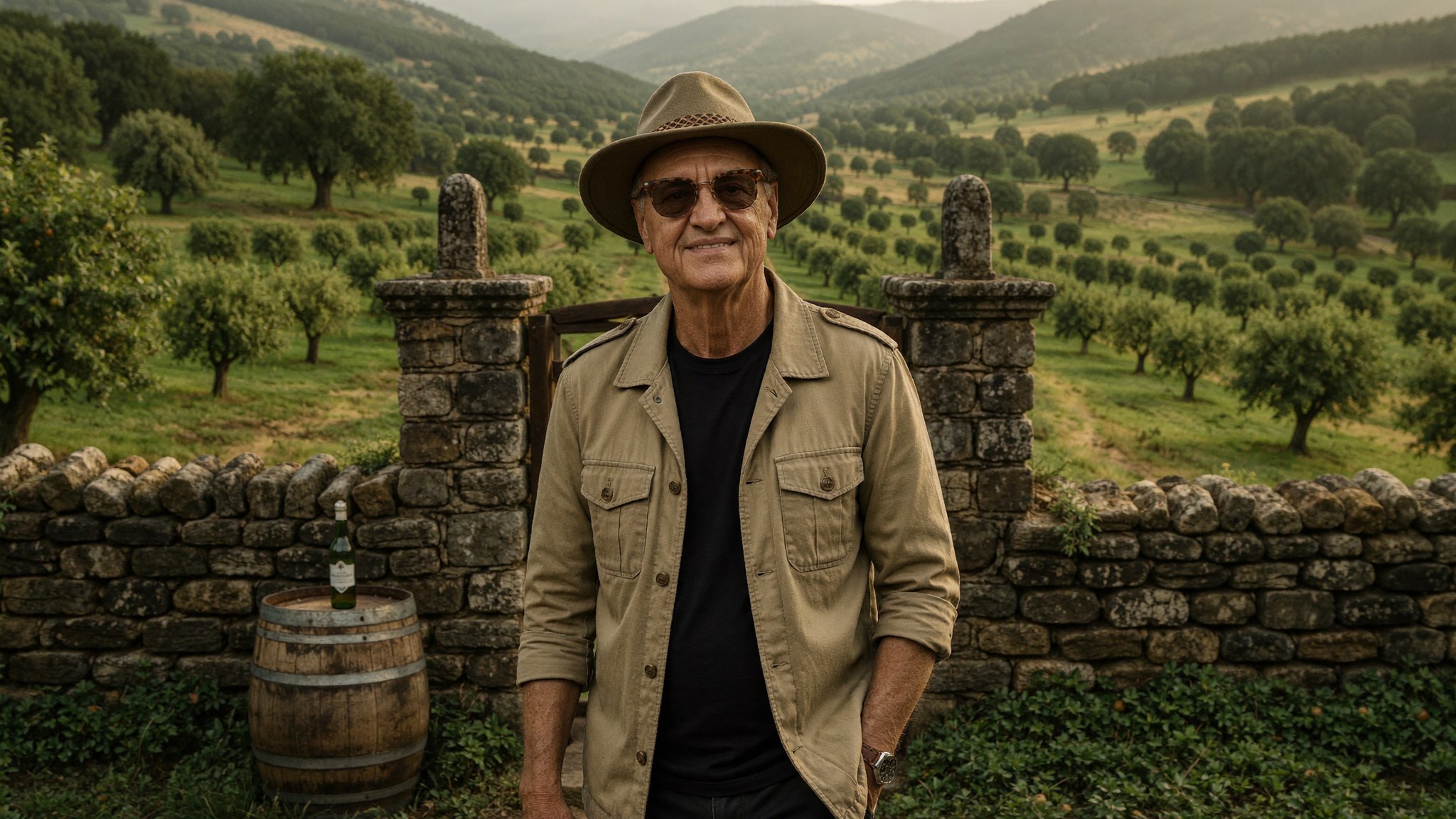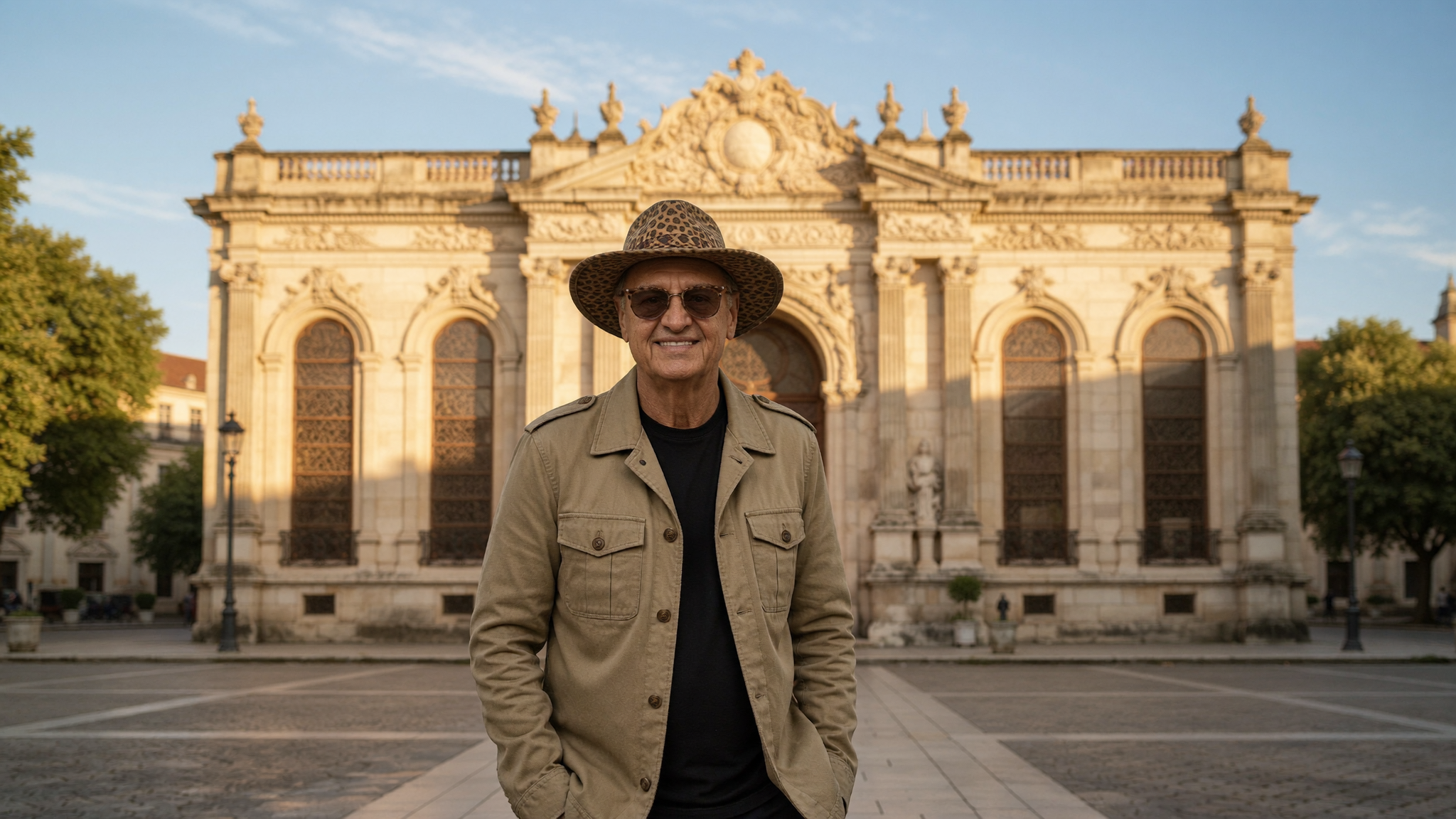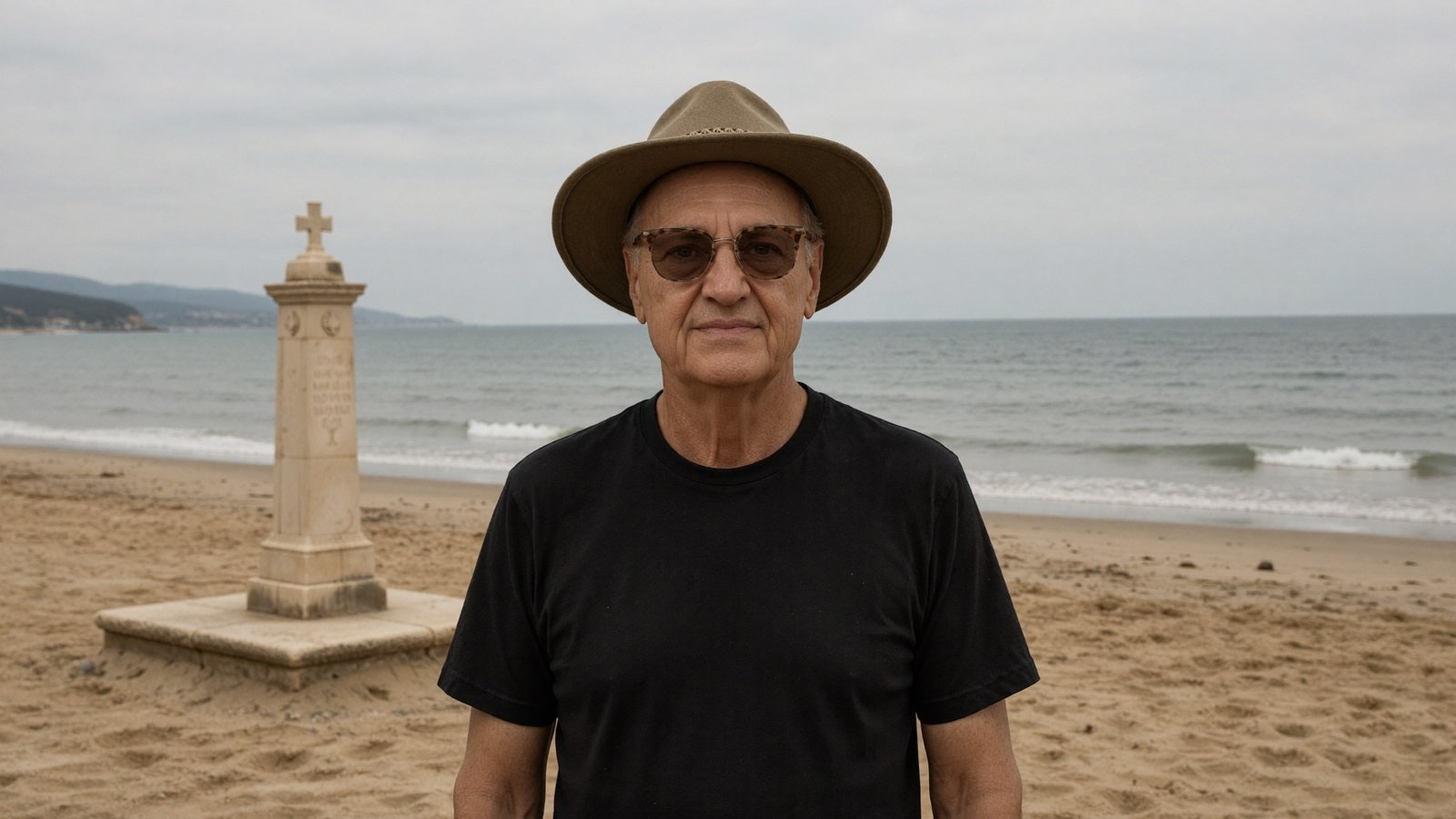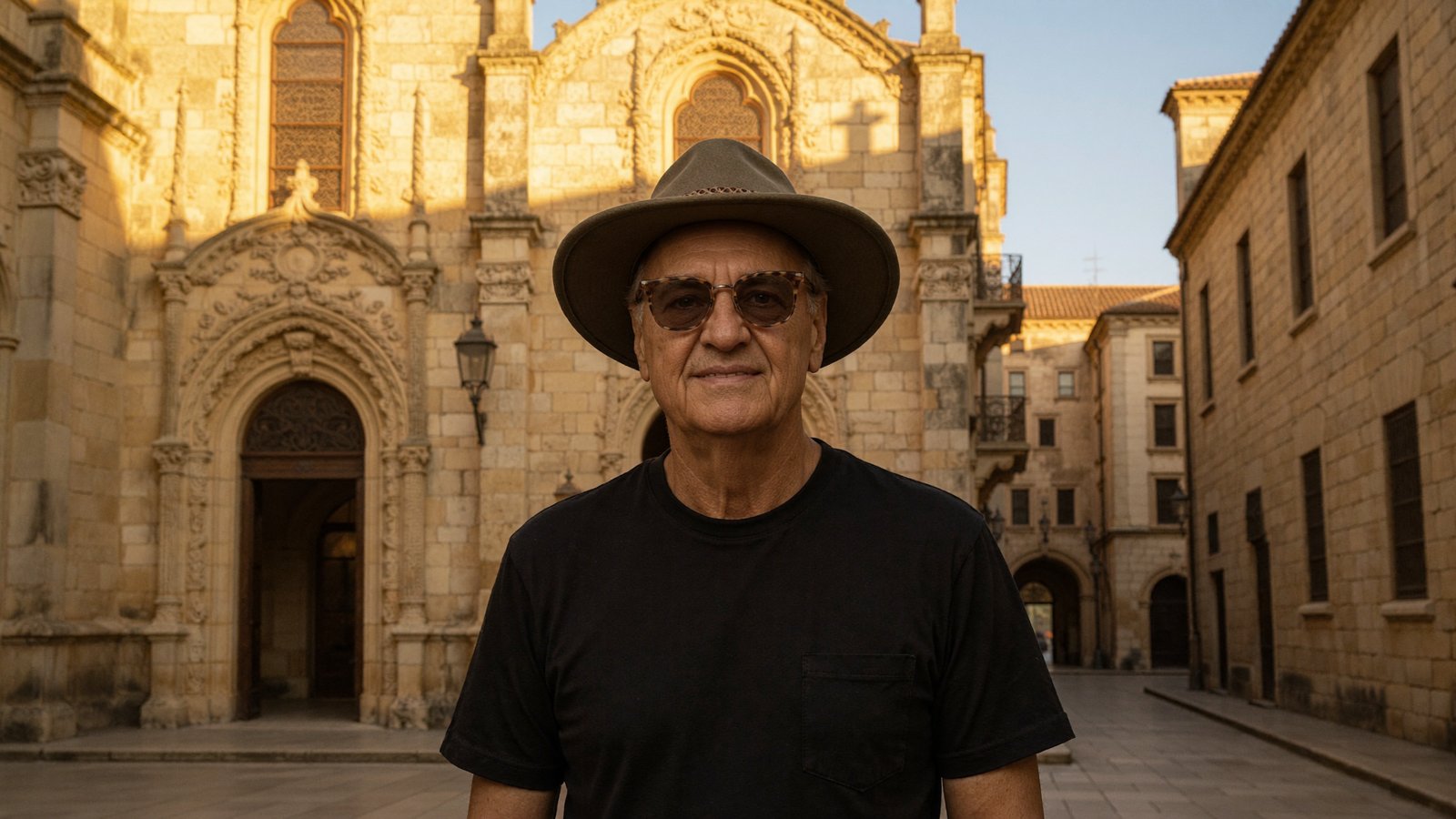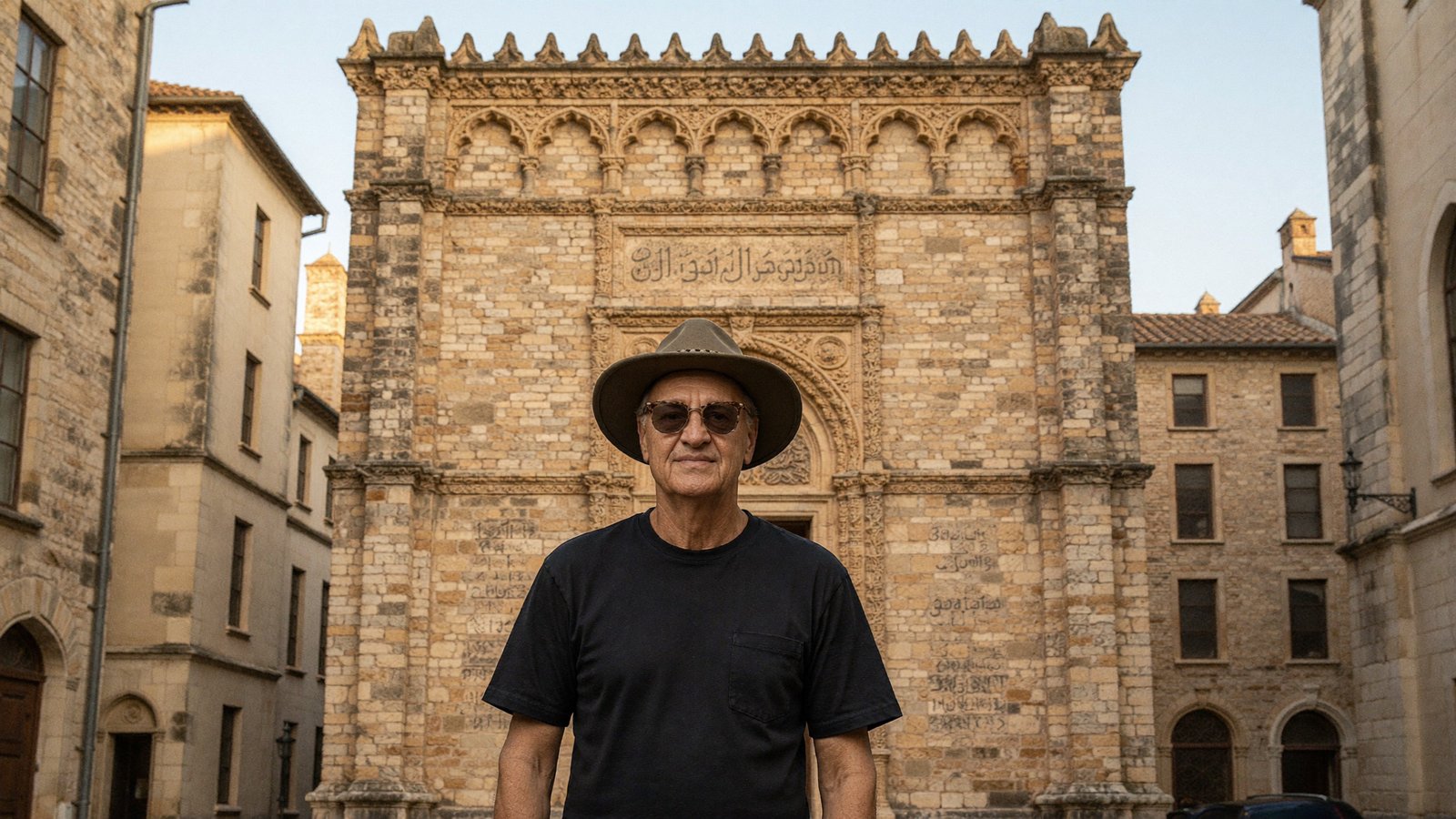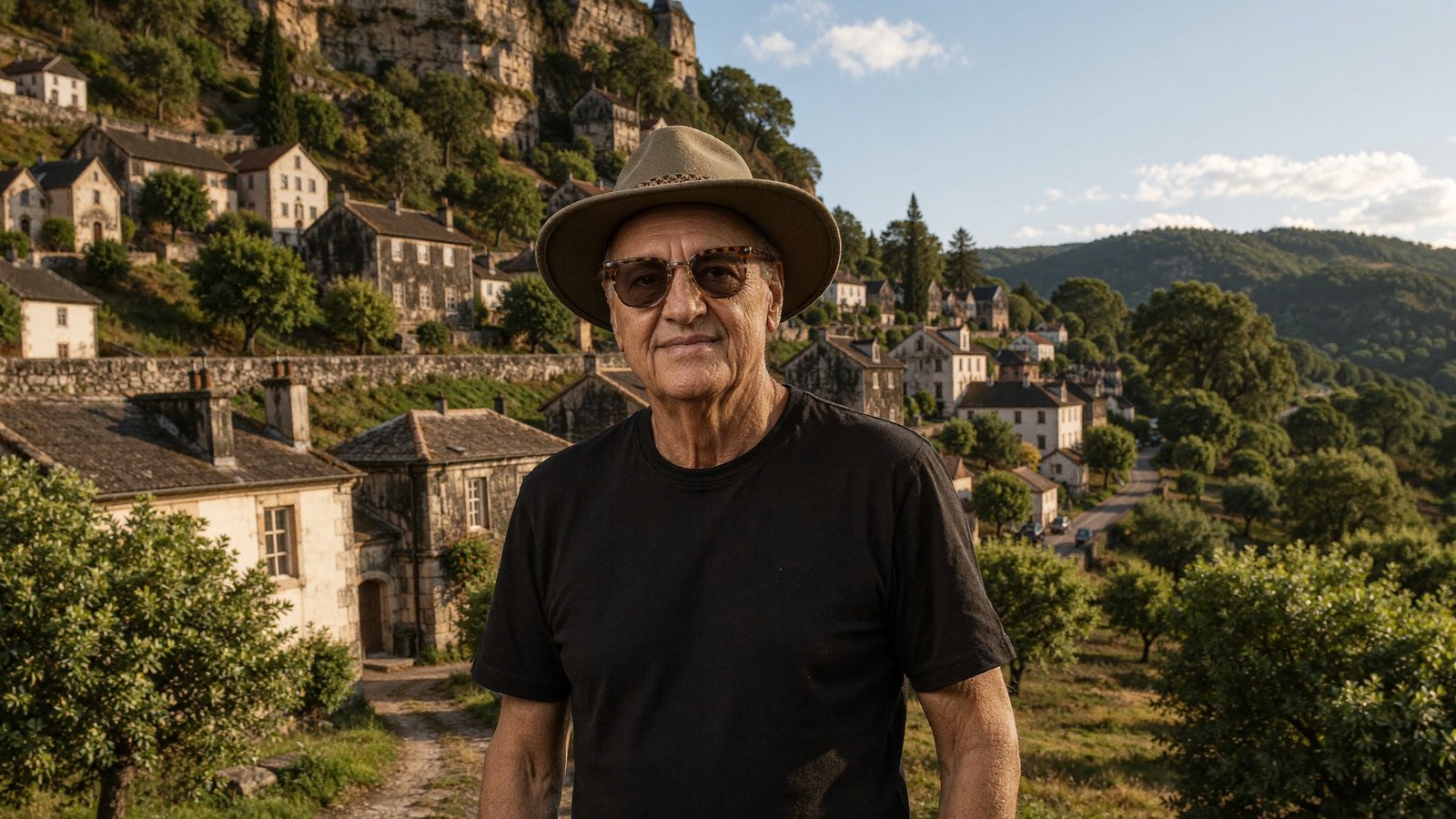
Your travel chronicle on Spain, focusing on the terraces of Banyalbufar in Mallorca, the Malvasia winemakers, and the merchants who transported this wine to London in the 15th century—a time when all of Europe was clamoring for the sweet wine the English called malmsey, while back in England, the Duke of Clarence was dying in the Tower of London in February 1478, entering legend inside a barrel.
Your Daily Iberian Travel Chronicle & Guide
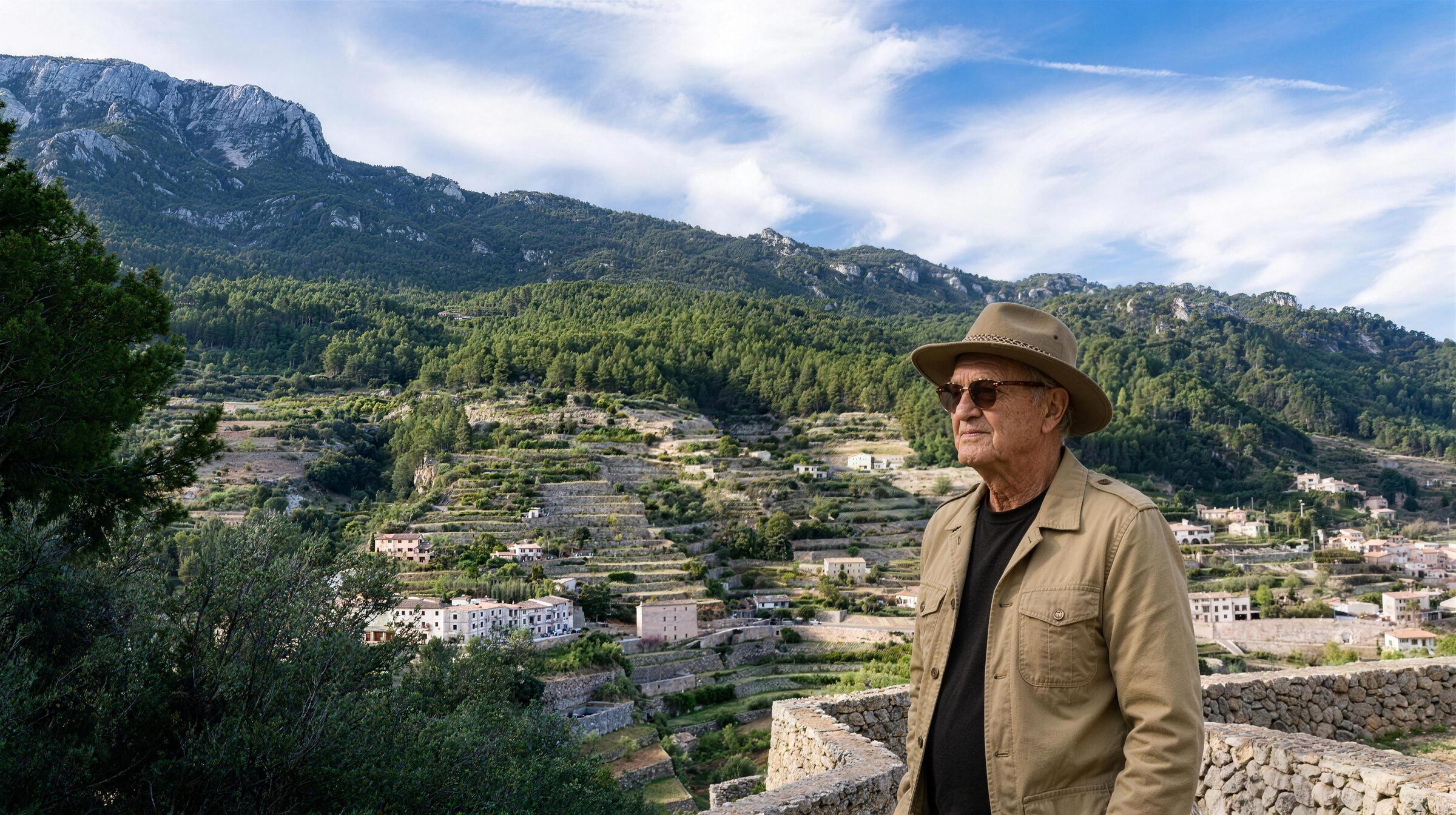
You know, there are villages you drive through without ever stopping. The road through the Serra de Tramuntana is full of them. It twists, it dips, it climbs, and every now and then, a bend opens up to reveal something that looks like a trick of perspective: an entire mountain carved into a staircase, from the summit down to the sea, as if someone had wanted to provide steps for the Mediterranean.
Banyalbufar appears just like that. Suddenly, after a turn. Two hundred and fifty year-round residents, four peaks surrounding it, and beneath the blonde stone houses, something few visitors truly notice: one hundred and sixty kilometers of dry-stone walls, built without mortar, stone against stone. One hundred and sixty kilometers. For a village where everyone knows everyone.
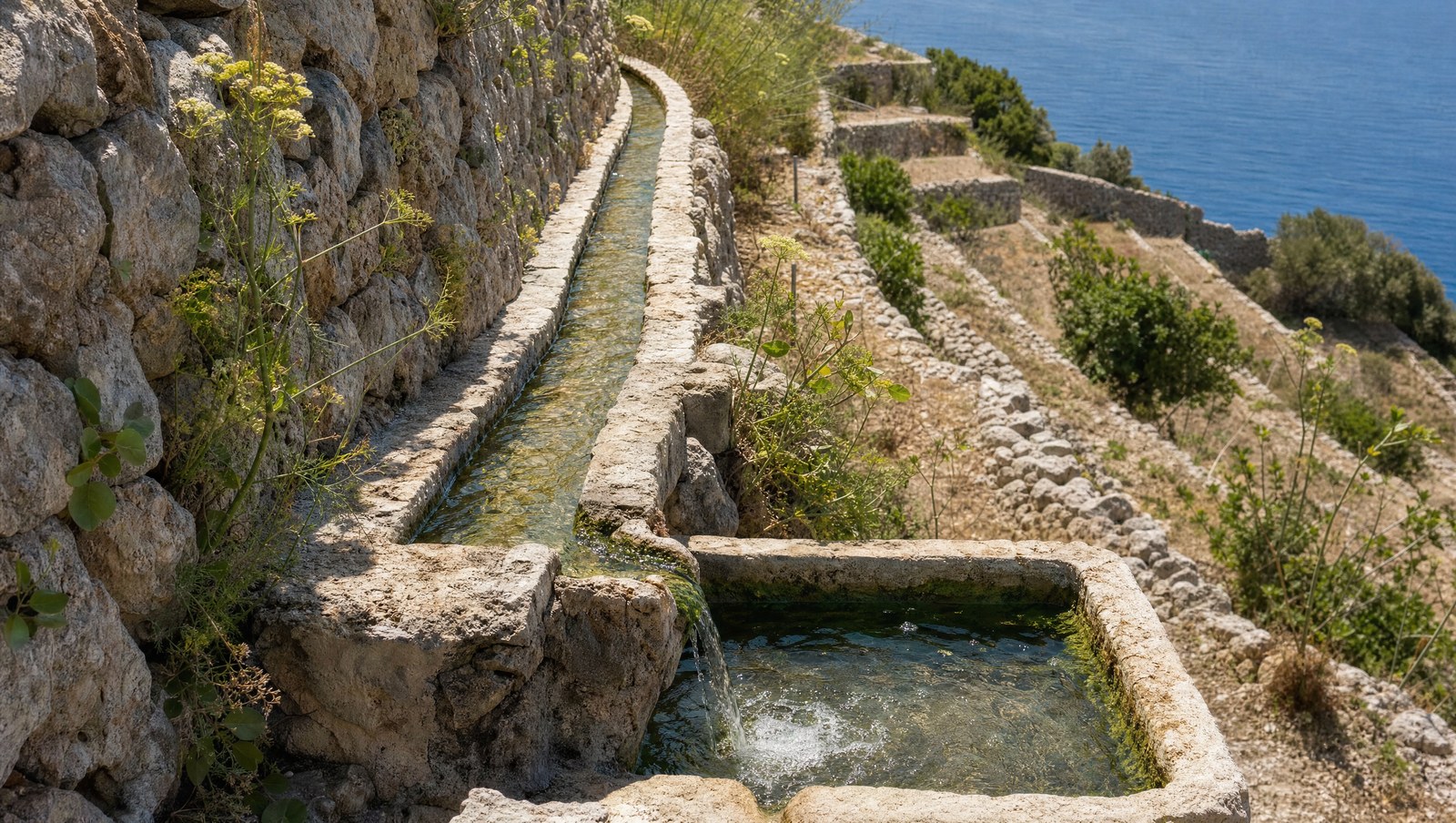
I arrived on a late September morning, when the light is still crisp but the air has already shed the heat of summer. It smelled of warm pine and salt. And somewhere below, a steady, almost annoying sound that you only understand after a few minutes: water. Water flowing, constantly, through a system that no one has thoroughly repaired in a thousand years.
The staircase no one has finished climbing
There were three of us descending the first path that morning, plus me.
Aina led the way. Twenty-five, Mallorcan, granddaughter of a winemaker, born just a few kilometers from here. She walked like someone at home, without looking at her feet, her hand trailing along the tops of the walls more out of habit than necessity.
Behind her, Eleanor was taking notes while standing, which is quite a feat on a path like this. English, thirty-three, she works on Shakespeare and the Renaissance wine trade—a combination that makes more sense than it seems, as you’ll see.
And Tomeu brought up the rear. Forty-four, Mallorcan, oenologist. He didn't say a word. He just touched the leaves.
"Do you hear that?" Aina asked, stopping abruptly.
We stopped. The sound of water was everywhere and nowhere, under the earth, behind the stones, beneath our feet.
"That’s Arab," she said. "All of it."
She was right, and the figure makes your head spin when you mention it in the middle of a field. The hydraulic system of Banyalbufar dates back to the Muslim occupation of the island. Seventy hectares of terraces, one hundred and ninety basins, eighteen kilometers of canals, and those famous one hundred and sixty kilometers of walls. The water descends from one basin to the next by gravity, each basin holding its share before yielding the rest to the next. A thousand years later, it still works. Not like a ruin maintained for photos. Like plumbing that actually works.
The Mallorcans call these terraces marjades, and the walls that support them marges. The word comes from an Arabic root that carries the idea of restraint, delay, and control. Holding back the water. Holding back the earth. Holding back the slope that, without these walls, would have slid into the sea long ago.
Tomeu crouched down and placed his palm flat against a stone.
"No one just let this happen. Someone built it. And someone else rebuilds it whenever it falls."
If you're reading this, take a second to think about that. This landscape isn't just a backdrop. It’s a man-made object, maintained and repaired, generation after generation, by people whose names no one knows. The day we stop repairing it, it will crumble back down.
The wine that London demanded by the barrel
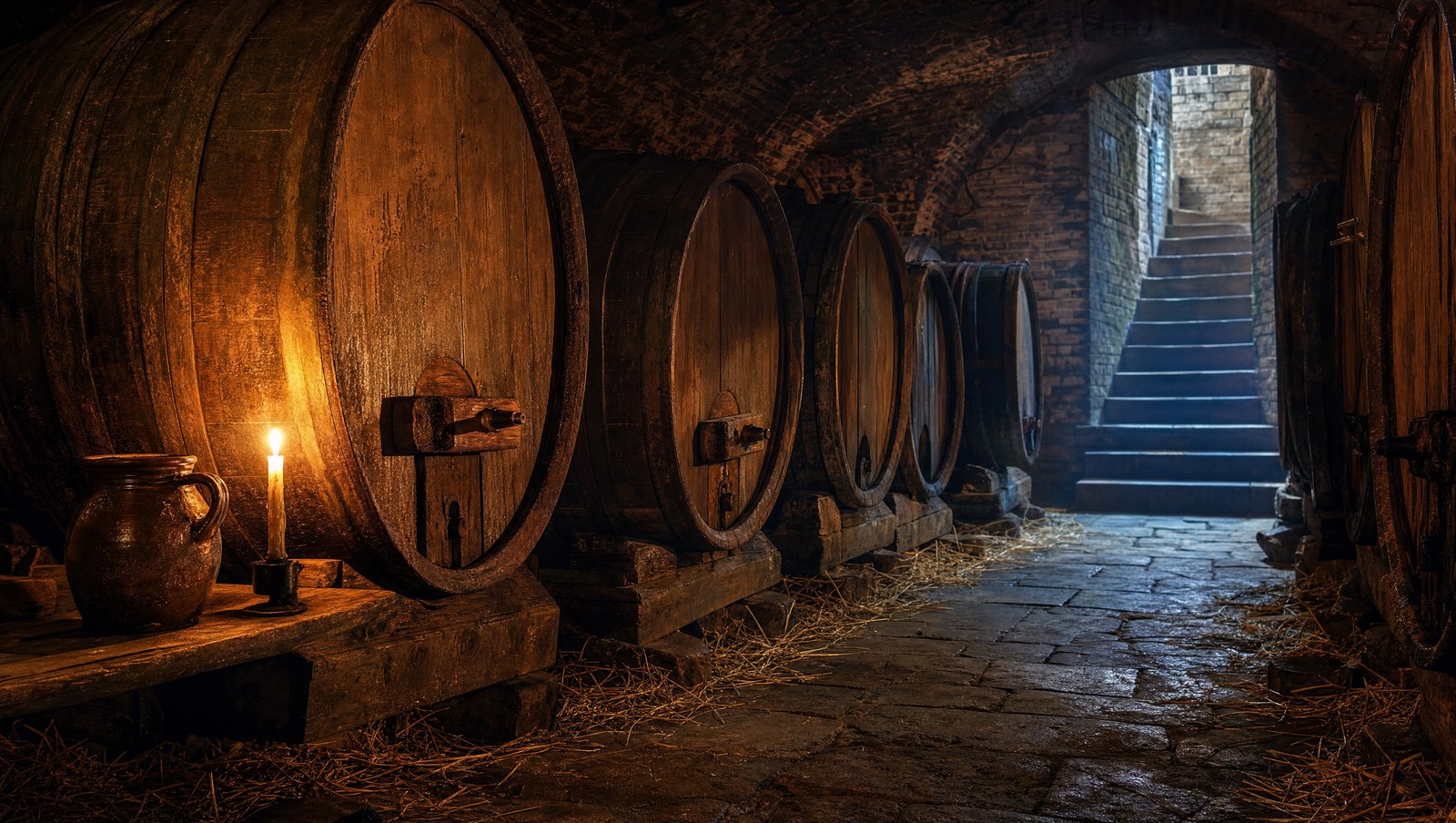
The village's name says it all. Banyalbufar comes from Arabic, and it is most often translated as the vineyard by the sea.
Because before the tomatoes, before the potatoes, before the hikers and the rental cars, these terraces grew grapes. And not just any grapes. Malvasia.
Eleanor closed her notebook at that exact moment, which, for her, is a sign.
"In England, they called it malmsey," she said. "And it was a craze."
She wasn't exaggerating. The word malmsey is an English corruption of malvasia, which itself comes from Monemvasia, a fortified port in the Peloponnese. The wine was originally Greek, then Cretan, back when Venice ruled Crete and flooded Europe with this sweet, dense liquid, packed with enough sugar and alcohol to survive weeks at sea without turning. In a Northern Europe that drank sour wine, this was a revelation.
England went wild for it in the 15th century. The Eton archives contain a tavern lease from Sandwich, Kent, dated December 4, 1458: the tenant agreed to pay five pounds per barrel of malmsey supplied, compared to six pounds, thirteen shillings, and four pence for ordinary red or white. The Greek wine cost less than the rest, yet it was the prestige wine. By 1570, England was still importing some twenty million liters a year.
"And that’s where it gets interesting for you," Eleanor continued, turning to Tomeu. "Greece and Crete were never enough. The demand was such that the grape spread. Cyprus. And Spain."
Tomeu nodded slowly, without smiling.
"So they planted it here to quench the English thirst."
"To quench everyone's thirst. The English just drank it harder."
Look closely, you who are reading these lines, at what this tells us. These walls beneath our feet, these canals, this water we’ve been disciplining for a thousand years—it all ended up serving a distant market, a courtly trend, a craving for sugar in lands where grapes don't ripen. A village clinging to a Balearic cliff was working, without truly knowing it, for the tables of London.
What we still talk about over a glass
We headed back up to the village in the late morning, and that’s when we met Sebastià.
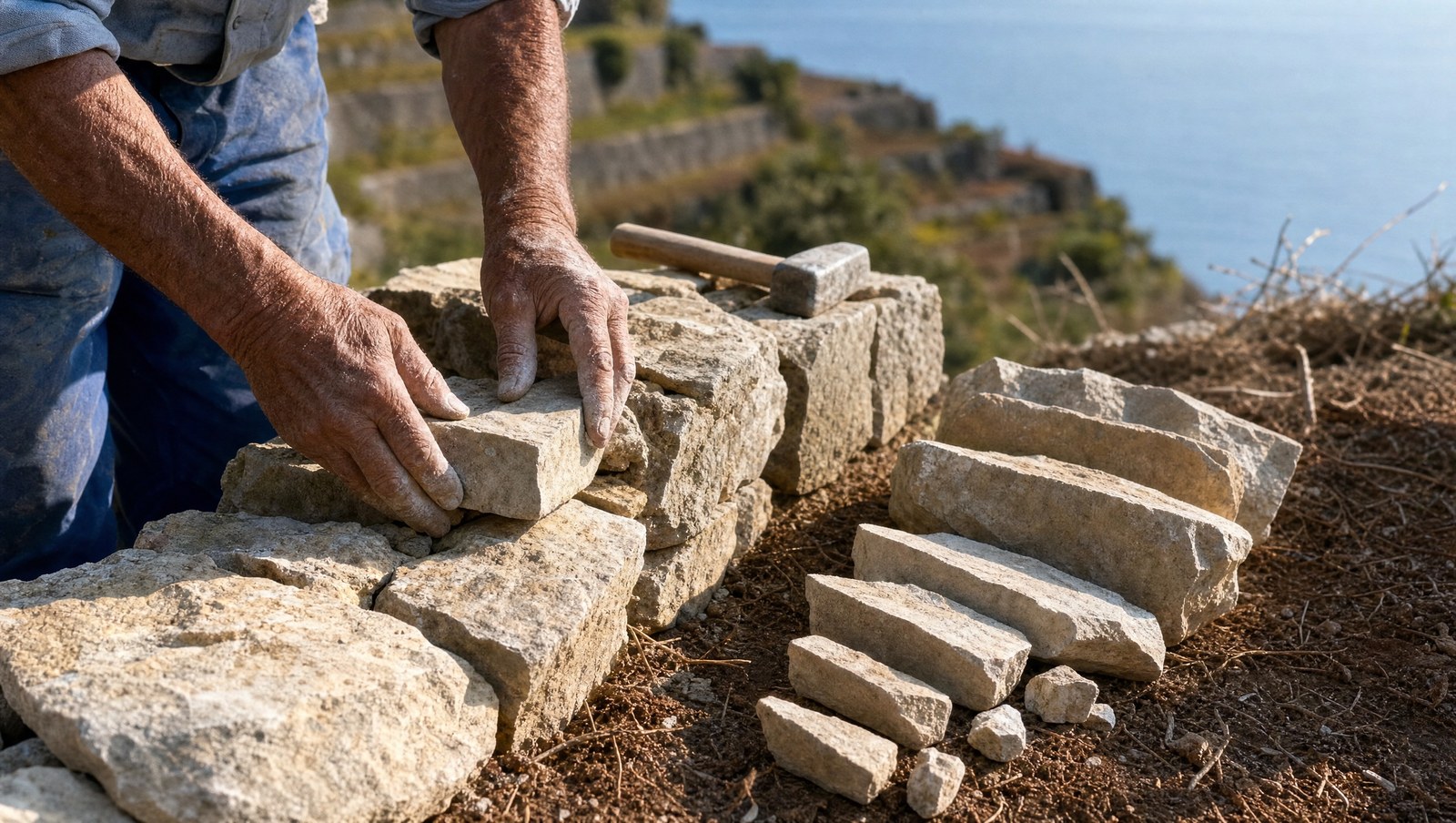
He must have been over seventy, wearing work overalls, kneeling before a gap in a wall. Beside him was a pile of stones sorted by size, like a serious child's game. He was rebuilding a dry-stone wall that had collapsed over the winter. He looked at us, wiped his hands on his trousers, and accepted the conversation with the unhurried pace of someone who has all the time in the world and knows it.
When Aina said the word malvasia, he looked up.
"Ah. So, let's talk about the king."
They say around here that James I of Aragon loved this wine to the point of madness. That he tasted it, never forgot it, and that this very taste might have influenced his decision to come and take the island. A conquest for a wine. Sebastià said it just like that, with the quiet pleasure of someone who has told this story a hundred times and still finds it good.
Eleanor waited politely for him to finish, then asked the question we all saw coming.
"James I took Mallorca in 1229. And historical records show the grape variety didn't arrive on the island until the 15th century."
Sebastià shrugged, unoffended.
"Two centuries. Yes." A pause. "It’s still a beautiful story, though."
He was right, and so was Eleanor, and that is precisely what I love about these moments. A legend doesn't become false just because you’ve dated it. It simply changes its nature. It stops being a piece of information and becomes what it has always been: the way a village tells the story of its own worth. Here, they made a wine so good that a king would have come to claim it by force of arms.
But Eleanor wasn't finished, and her own legend is darker.
On February 18, 1478, George Plantagenet, Duke of Clarence and brother to King Edward IV, was executed in secret at the Tower of London after being convicted of treason. Shortly after, a rumor spread: he hadn't died by the axe, but had been drowned in a butt of Malmsey wine. A century later, Shakespeare immortalized the scene in Richard III and etched it into the English consciousness forever. He even mentions this wine in two other plays, as one mentions something everyone knows.
"And is it true?" Aina asked.
"No," Eleanor replied. "Well, we can't prove it. The execution was private, historians lean toward beheading, and the drowning story appeared later. It’s likely a metaphor. He was drowned in his own vice."
Tomeu gave a professional little chuckle.
"Two legends. A king who invades for a wine, a duke who dies in one. This wine has a complicated relationship with the truth."
What the terraces yield when they no longer yield wine
At one o'clock, Sebastià set down his last stone of the morning and gestured with his chin toward an open door further up the street. "Go eat. I'm finishing up."
The dining room is tiny, six or seven tables, a fan stirring the air without much conviction, and a narrow terrace that looks straight out over the void. Below, the *marjades* descend, and behind them the sea, flat and hard under the midday sun. It smelled of hot olive oil and garlic, that scent that grabs you the moment you walk in and decides for you what you’re going to order.
Tomeu ordered for everyone, which I always let people do when they are on their home turf.
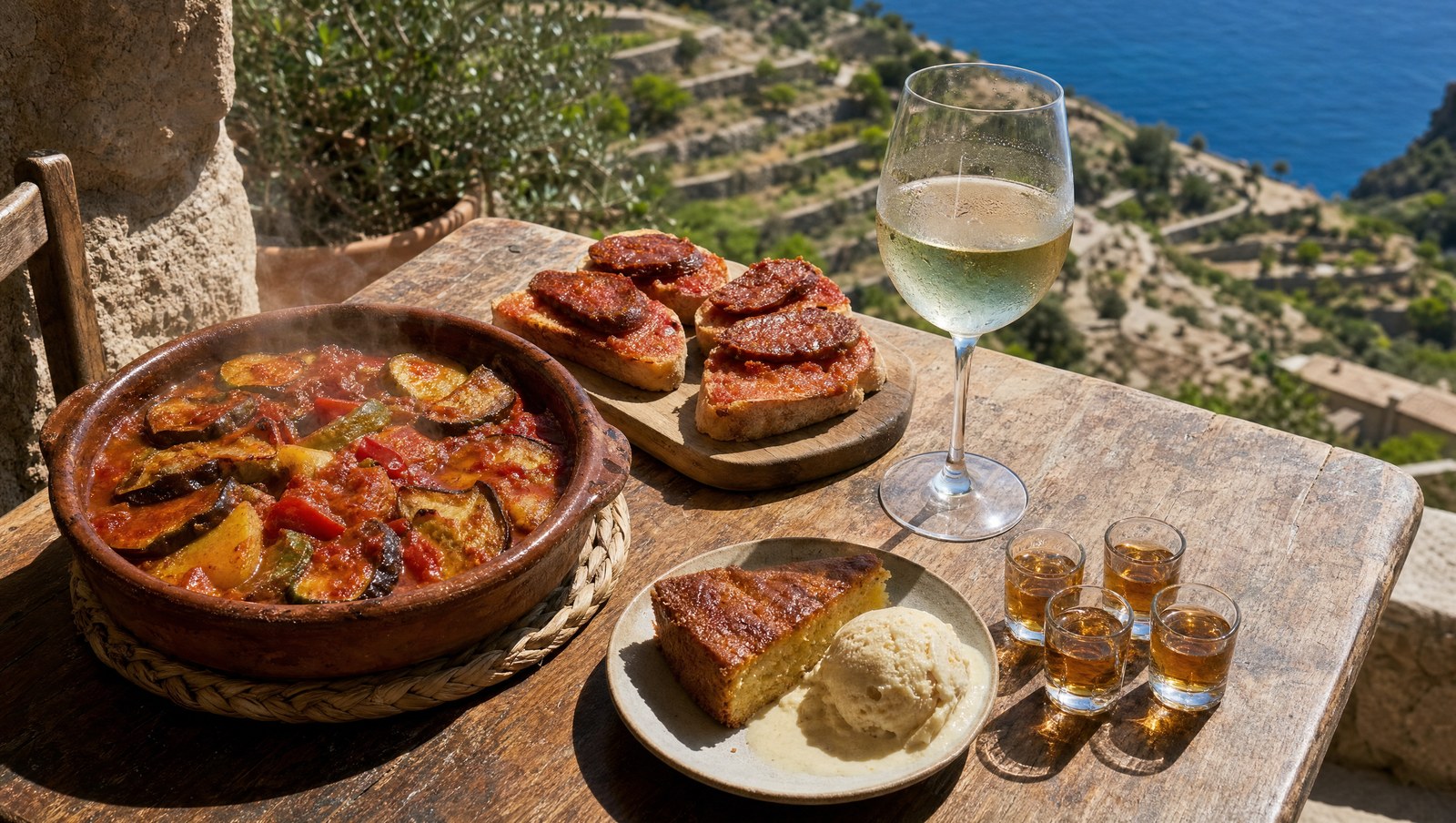
First, *pa amb oli*. Slightly dry brown bread, rubbed with *ramallet* tomato—that island variety kept hanging in bunches all winter—drizzled with olive oil from the Serra, and topped with slices of *sobrassada*, that paprika-spiced sausage you can't find anywhere but the Balearics. You eat it with your fingers. The oil runs down your wrist. No one apologizes for it.
Then came the tumbet, served in an earthenware dish still too hot to touch. Eggplant, peppers, potatoes, zucchini—each vegetable fried separately before being stacked in layers and drowned in a slow-cooked tomato sauce. It’s a dish that looks simple but is anything but. Every layer retains its own flavor: the melting eggplant, the potato that still has a bit of bite, the pepper that sweetens the whole thing.
Eleanor was the first to see what I had missed.
"Wait," she said, putting down her fork. "The potatoes. The tomatoes. Is that what we planted instead of the vines after the phylloxera?"
Aina nodded, her mouth full.
"So we’re eating the century when the wine disappeared."
No one answered right away. We just looked at the dish differently. For those of you reading this, it’s one of my favorite parts of this job: when history stops being something you talk about and becomes something you have on your plate.
To go with it, Tomeu had ordered a bottle of the village’s dry Malvasia. Cold, crisp, with that saline finish you get from seaside vines. It held its own against the tumbet without ever overpowering it.
Dessert arrived unbidden. The gató, a Mallorcan almond cake—dense, slightly crumbly, served warm with a scoop of almond ice cream already melting on the edge of the plate. Almond trees are everywhere on this island, and this is the kind of cake you learn to make at home long before you ever order it out.
And at the end, with the bill, the owner placed four small glasses of hierbas on the table without a word. It’s the custom here; you don’t ask for it, and you don’t pay for it. A liqueur made from about thirty different plants, inherited from the concoctions that monks and apothecaries distilled in the 16th century to fight epidemics. Bitter, sweet, ice-cold. It closes a meal the way you close a door.
The vine forgotten in a garden
What happened next isn't a legend, and that’s why it moved me so much.
In 1891, phylloxera reached Banyalbufar. The aphids devoured the roots, the vineyard died, and it never recovered. The terraces didn't stay empty, though, because a mountain village can't afford to let seventy hectares lie fallow: they planted tomatoes and potatoes instead. The vines, however, vanished. The wine that had made the place famous stopped dead.
For nearly a hundred years, there was no more Malvasia in Banyalbufar.
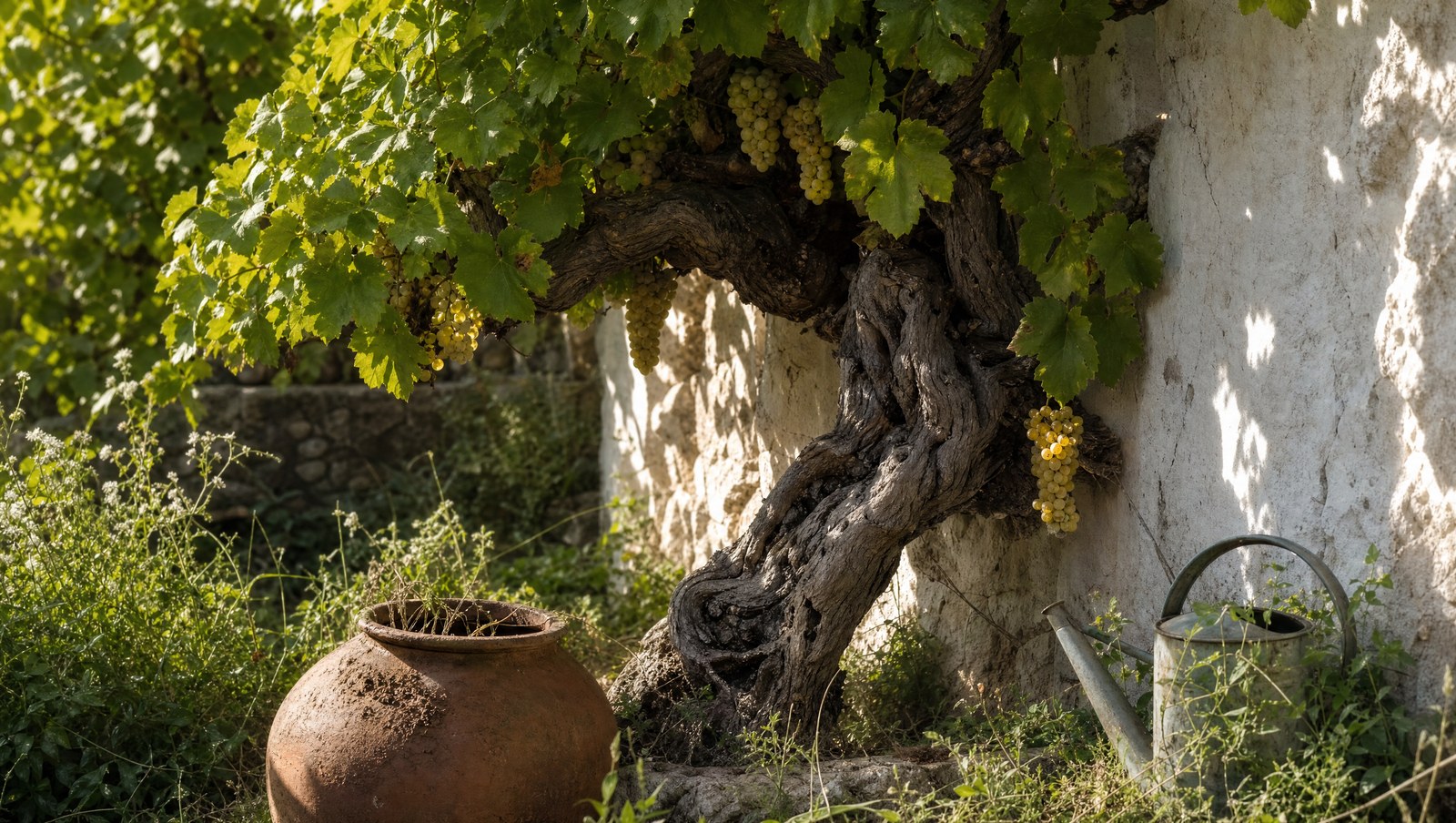
Then, in the 1980s, a handful of locals stumbled upon a surviving vine, forgotten in someone’s garden. Just one. Sick, exhausted, but alive.
They sent it to Italy for a complete cleanup, then had it propagated in vitro. Two hundred and fifty plants came out of it. Two hundred and fifty. The same as the number of inhabitants in the village—a coincidence, but one that makes you want to sit down for a moment.
In 1999, a program funded by the Balearic government produced healthy, virus-free, agronomically sound clones. In 2000, a former mayor, Toni Mora, founded the Malvasia de Banyalbufar cooperative with five friends. People who gave their land, their evenings, their weekends. In 2006, this Malvasia became the first in Spain to obtain a health certificate, and it remains the only one.
Aina listened to Tomeu tell the story, looking away toward the sea.
"My grandfather used to say he would never see it again."
She didn't add anything else. There was nothing to add.
You, my reader, may have already dreamed of a place like this. A village where people know each other by name, where the sea is down below, where the light does what it does here in the late afternoon. It’s a legitimate desire, and I’m not going to sell it to you with adjectives. But if you come, look at the walls first.
Because what holds this landscape together is neither the climate nor the view. It is the people who put back fallen stones, clear out canals, carve terraces where no machine can climb, and who waited a hundred years to rediscover a grape variety. This village isn't really for visiting. It is for maintaining.
What still grows after the cars have left
We ended the day at the cooperative on the main street, a tiny space that sells three wines.
Tomeu poured. The dry one first: taut, saline, with that bark-like bitterness that seaside vines provide. Then the sweet. And there, frankly, you understand the 15th century. It is thick without being heavy; it is honey and dried apricot, it lingers, it warms the chest. You understand why they loaded it into barrels for three weeks at sea. For a sip, you even understand how someone could invent a king who would cross the Mediterranean for it.
Outside, the light fell upon the terraces, and the walls cast their shadows in sharp, parallel lines all the way to the bottom. The last cars of the day sped along the cliff road without slowing down. An hour earlier, it would have looked like a viewpoint. Now, we saw a thousand-year-old construction site.
Sebastià was still up there on his wall. He had four or five stones left to set before nightfall.
" Sa pedra sap on ha d'anar ," he had said in the afternoon when Eleanor asked him how he chose. The stone knows where it needs to go.
And you, reader in the shadows, when you look at a landscape, what do you really see? A postcard, or the work of thousands of anonymous hands that decided, one day, that this slope was worth holding back?
Banyalbufar wine has fed foreign courts, appeared in a Shakespeare play, vanished for a century, and returned from a garden. It is barely drunk anywhere else. Production is counted in thousands of liters, not millions. It is small. Above all, it is stubborn.
Category: Wines · Country: Spain · Location type: Vineyards
You know, seeking out these stories comes at a price. Traveling to these places, consulting archives, verifying every date with historians—it takes time, and for an independent author, time is the only currency that truly matters.
If these stories move you, supporting this work will cost you less than a coffee and a glass of Spanish wine. For €5 a month, you aren't just supporting an independent author: you are joining a community of active Iberophiles and participating each month in the birth of a new narrative. You vote for the story that interests you and that you want to see written. If your choice wins, your name is engraved at the bottom of that article, published for all to read and recognized by other readers as the one who brought it to life. A text you can recount and discuss at your dinner parties with friends and everyone with whom you share your love for Portugal and Spain, a text that will help other Iberophiles better discover these lands. Each month, your voice counts again, helping this vibrant, participatory community grow a little more.
And as long as you are a member, the entire Library is open to you: 14 ebooks already written, with a total value of €138.60, included in your subscription.
👉 I'm becoming an active Iberophile
If you ever leave, no ebook truly disappears: you will always be able to purchase them individually for €9.90 each.
Because a journey never truly ends. It continues, somewhere between the pages and the memories.
Lucas Lunes, author of Ancient Stones