Listen to the story — narrated version
Your travel chronicle on Spain, focusing on the cider houses of Asturias, the Basque and Norman sailors (9th–12th centuries), and the era when the apple tree traveled from one Atlantic shore to the other, while in Normandy, around 1082, the first written mention of "sidre" was being recorded.
Your Daily Iberian Travel Chronicle & Guide
You know, there are some actions that defy explanation. You watch them, you think you understand, and then you realize it takes an entire region, an entire history, to hold an arm that high without trembling.
It was in Nava, a green village in Asturias, that I first saw this gesture up close. A man, bottle raised above his head, glass braced against his hip, a meter of empty space between the two. And the cider falling, cloudy and golden, striking the rim of the glass, bursting into a fleeting foam, then dying away instantly. You have to drink quickly, before the magic fades. Look closely, you who are reading these lines: this isn't a parlor trick for tourists. It’s a way of bringing something to life that, without this gesture, would remain dormant.
It’s called *escanciado*. And behind this word lies one of the most beautiful stories the Atlantic has ever told to two shores at once.
Arrival in the valley of the apple trees
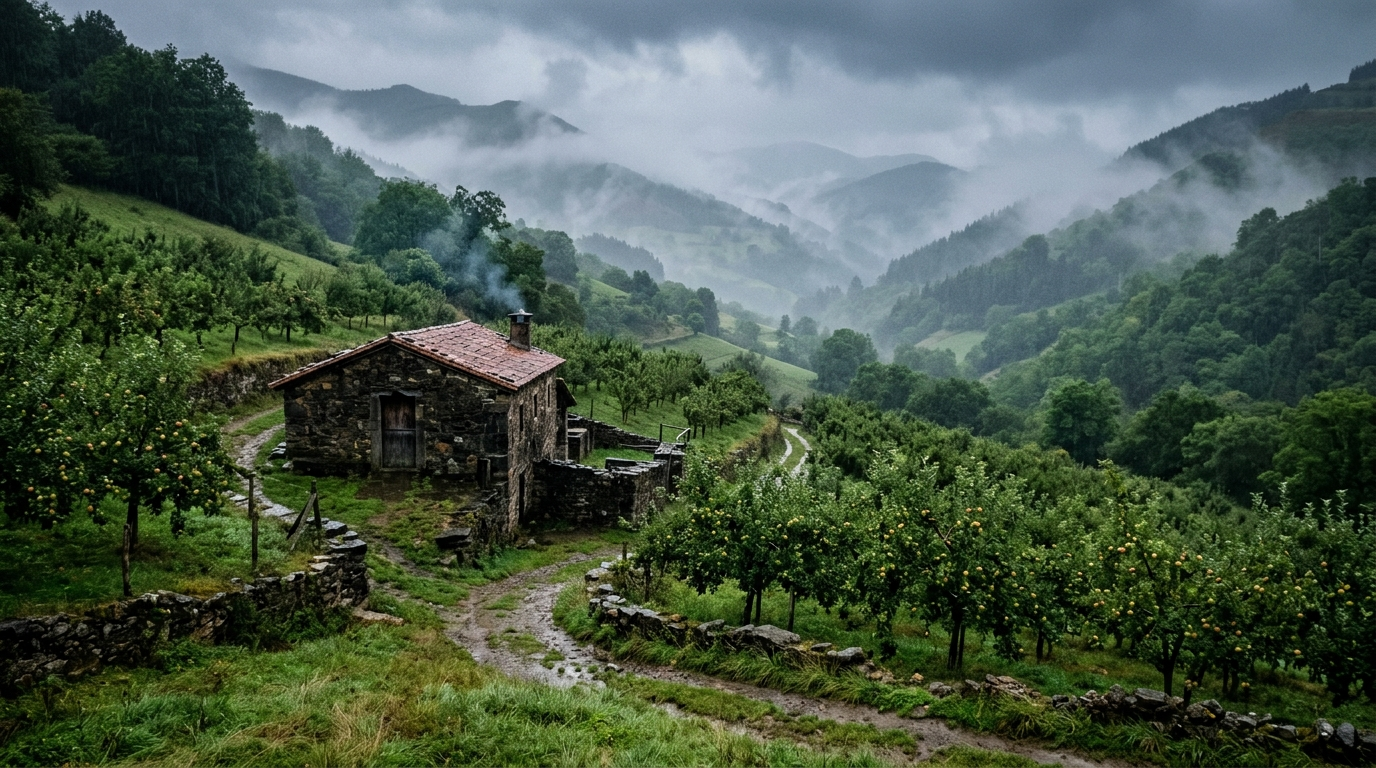
It was raining when I arrived, that fine, stubborn rain that gives Asturias its impossible shade of green. Nothing like the scorched plains of Castile or the white heat of Andalusia. Here, everything flows, everything breathes, and the air smells of ripe apples and damp earth.
Three people were waiting for me under the awning of a *llagar*, a traditional cider house with dark stone walls.
There was Covadonga, sixty years old, daughter and granddaughter of apple growers, born just a few kilometers away. She has the kind of face you find on people whose family has never left their valley, a face that resembles the landscape. "Bienvenido," she said, before adding with a laugh that cider here "isn't a drink, it's a language."
Beside her was Camille, twenty-nine, a French ethnologist who had come to study the cider traditions of the Atlantic arc. She was already scribbling in a soaked notebook, squinting at the man who, further away, was pouring cider for a few regulars. "Did you see the height?" she whispered to me, fascinated. "Back home in Normandy, we never pour it like that."
And then there was Rubén, forty-eight, a master cider maker with broad, calloused hands and sharp eyes. He was the one who would open the doors of his *llagar* to us, show us his barrels, and, most importantly, reveal the secret of the gesture. He looked at the three of us, wiped his palms on his apron, and simply said: "So, you want to understand cider. Good. But you don't understand cider with your head. You understand it with your arm, and with your throat."
You who are reading this, admit it: you would have smiled, too.
The gesture that brings life

Rubén led us inside. The smell grabs you by the throat immediately—a thick scent of fermentation, damp wood, and apples, almost animal. Chestnut barrels lined the dim room, as tall as men. On one of them sat a green bottle, label-less and uncorked.
"Natural Asturian cider has no gas," Rubén explained as he grabbed the bottle. "It’s flat, quiet, asleep in its glass. If you pour it gently, you’re drinking dead juice." He raised his arm in a slow motion, the bottle above his skull, the wide, thin glass lowered to hip level. "So, we wake it up."
The stream of cider fell from high above, struck the inner rim of the glass, and there, before our eyes, it began to foam. A light, ephemeral froth that suddenly released a scent of tart apple I hadn't smelled in the bottle. "That’s called the *espalme*, the foam," Rubén said. "It only lasts a few seconds. That’s why we only pour a splash, a *culín*, and drink it in one go."
Camille was scribbling at top speed. "Oxygenation," she murmured, more to herself than to us. "The impact against the glass aerates the cider, wakes up the aromas. It’s chemistry, but done with the body." Rubén shrugged with a half-smile: "You call it chemistry. We call it respect."
He handed us the glass in turn. The first sip surprised me: dry, tart, almost sharp—nothing like the sweet, sugary ciders I knew. A hint of bitterness, a lively freshness, then nothing, as if the cider erased itself. "Low alcohol," Rubén clarified, "between four and six percent, no more. Here, we don't drink to get drunk. We drink to be together." And it was true that there was, in that fragrant dimness, something deeply shared—a conviviality that was both rugged and warm.
Rubén told us that in Gijón, one day, more than eight thousand people gathered on the beach to pour cider together at the exact same moment, breaking a world record. "Eight thousand arms raised to the sky," he said, his eyes shining. "Can you imagine that? An entire region raising their arms at once." You who are reading this, really imagine it: an entire beach, eight thousand streams of cider falling at the same time, eight thousand little ephemeral foams under the sun of the Bay of Biscay.
This cider, it bears repeating, is no mere folk curiosity. In 2024, UNESCO recognized the cider culture of Asturias as Intangible Cultural Heritage of Humanity. Not the drink itself, mind you: the culture. The technique, the transmission, the llagares, the escanciadores competitions held annually since 1993—all this living fabric that Covadonga carries in her blood and that Rubén holds at arm's length.
Two shores, one apple
It was as we stepped back out into the rain that Camille asked the question that would open everything up.
"Rubén, why Asturias and Normandy? Two regions hundreds of miles apart, yet the same green, the same apple trees, the same passion for cider. Coincidence?"
The master cider maker looked out at the mist-drenched valley. "Nothing is a coincidence with the sea," he said.
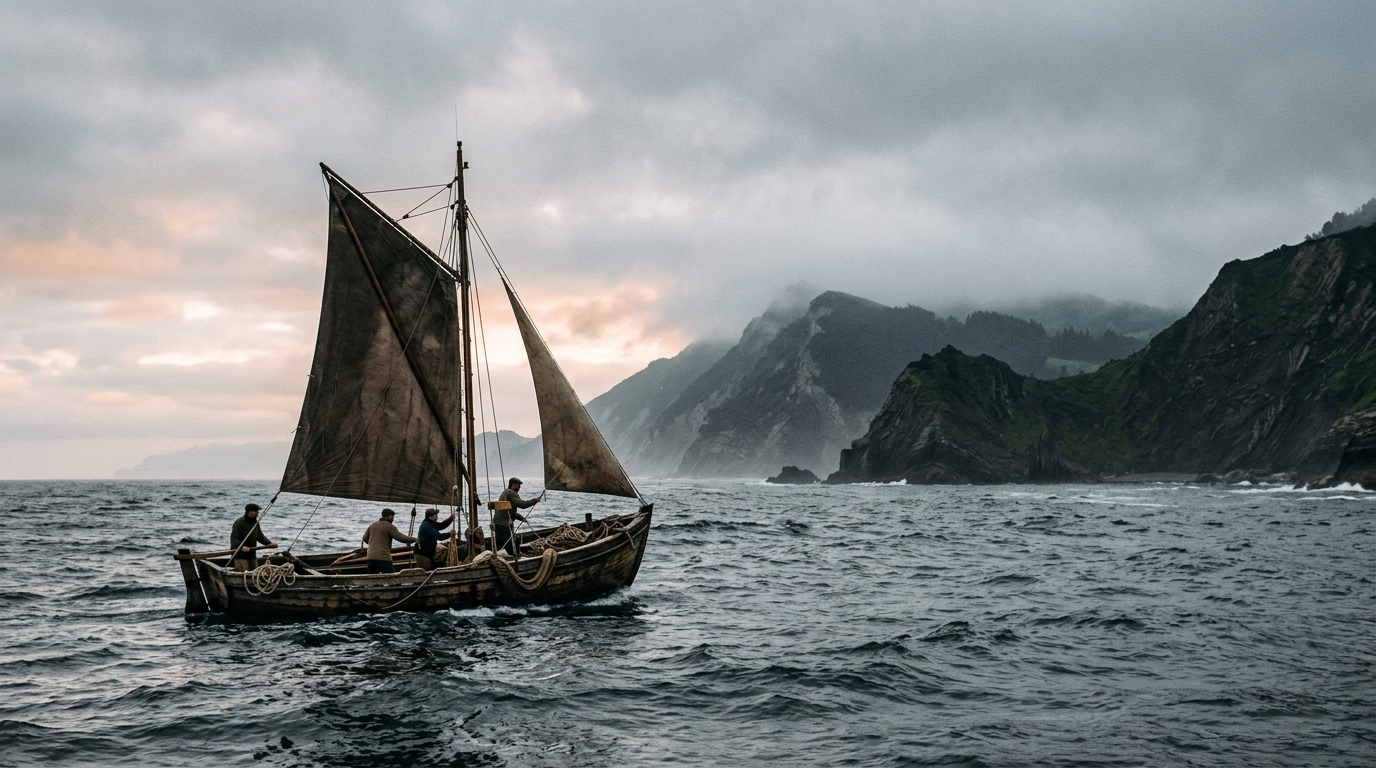
And here, dear reader, let me tell you what few people know. Long before borders, before nations, there was the Atlantic, and on the Atlantic, there were sailors. The Basques and the Normans had known each other since the early Middle Ages. As early as the 9th century, the Normans—the only known whale hunters in Europe at the time—sailed down to hunt Biscayan whales as far as the Bay of Biscay, along the Basque and Cantabrian coasts. They crossed paths, traded, and exchanged much more than just fish.
The cultivation of cider apples, known since antiquity in the Mediterranean, followed these sea routes. In the 12th century, Basque sailors helped spread the cider apple to Brittany and Normandy through these exchanges. In Normandy, the first written mention of "sidre" dates back to 1082, and around 1130, the Norman author Wace established the name for the first time in the sense we know today.
"And the name itself proves it," added Camille, regaining her ethnographic enthusiasm. "Sidra in Spain, sidre then cidre in France, cider in England, sider in Italy. All these variations come from the same root, the Latin sicera. A single word that traveled from mouth to mouth, from port to port, all around the Atlantic." She paused. "We think languages separate us. Sometimes, they tell us we’ve been together from the start."
Covadonga smiled. "Go to Oviedo, to Gascona Street, what we call the Cider Boulevard. The name comes from the pilgrims from Gascony, in France, who used to settle there on the Camino de Santiago. There, too, France and Asturias touch, in the name of a street where cider flows." Nothing is a coincidence with the sea, indeed.
Camille had stopped writing. "So the apple of the North and the apple of the South are sisters," she said softly. "They traveled on the same ships."
"Sisters, yes," replied Covadonga. "But raised differently. Where you are, you filter, you sweeten, sometimes you make it sparkling. Here, we leave the cider wild, cloudy, and we bring it to life with our arms. Two daughters of the same mother, the Atlantic."
You, dear reader, think of this the next time you raise a glass of cider in Normandy: somewhere, on the other side of the gulf, an Asturian is raising theirs a meter above their head, and you are both drinking, without knowing it, to the same thousand-year-old history.
The legend of the apple and the queen
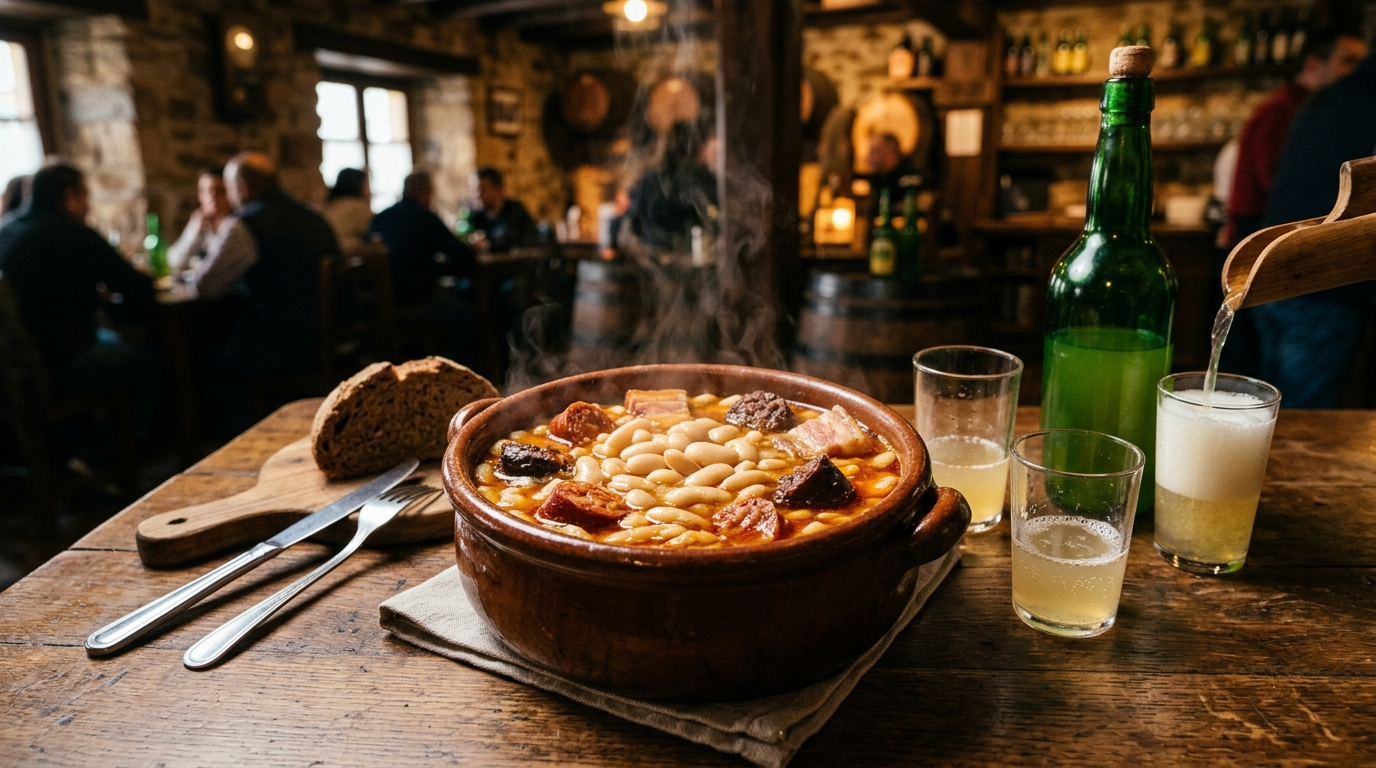
It was at the table, later, that the legend came up. A steaming fabada had been placed before us, that Asturian cassoulet of white beans and cured meats, and Rubén was filling the glasses, culín after culín.
An old man was eating alone at the next table. Covadonga knew him, greeted him, and he approached, glass in hand. His name was Fernando, and he said he was "the age of the old apple trees." When Camille asked him where Asturian cider really came from, his eyes lit up.
"They say, here," he began, lowering his voice, "that in the time of the kings of Asturias, when this small Christian kingdom was resisting alone in the mountains, a queen fell ill. No remedy could cure her. An old peasant from the valleys brought her a cloudy drink, drawn from his apples, served from very high up so that it would be lively and sparkling. The queen drank, and regained her strength. Since then, they say, we pour cider from as high as we can, so that life returns to it with every sip."
He smiled and downed his glass in one go. "That is what they say."
Covadonga nodded tenderly, but Camille, being an ethnologist, quietly nuanced: "It’s a beautiful story, but no text confirms it. The truth is that the escanciado is primarily used to oxygenate a cider that lacks gas. The legend was added to the gesture after the fact." Fernando heard her, and far from being offended, he laughed: "Of course, my dear. But tell me: does it make the cider taste any less good, knowing that a queen might have drunk it before you?"
And there, no one knew what to answer. Because that is exactly what the soul of Asturias is: one foot in science, one foot in dreams, and a glass between the two.
The last culín
The rain had stopped when we stepped back outside. The valley was steaming, the apple trees were dripping, and the late afternoon light gave everything the sheen of soft metal.
Rubén poured us each one last culín outside, under the clearing sky. The cider foamed once more, then went still. "Drink now," he said. "Cider waits for no one."
Camille put away her notebook. Covadonga looked out over her valleys with the eyes of someone who knows they are exactly where they are meant to be. And I, dear reader, thought of all those hands on both shores of the Atlantic that, for a thousand years, have poured the same fermented apple, each in their own way, each with their own truth and legend.
Some journeys change you because they show you palaces. Others, rarer still, change you because they show you a gesture. A simple gesture—a raised arm, a glass extended—and suddenly a thousand years of history rise to the surface in a second of foam.
"Salud," said Rubén.
"Salud," we replied.
And the cider, one last time, tasted of rain, of apples, and of everything the Atlantic has never ceased to connect.
Category: Gastronomy · Country: Spain · Place type: Villages
You know, seeking out these stories comes at a price. Traveling to these places, consulting archives, verifying every date with historians—it takes time, and for an independent author, time is the only currency that truly matters.
If these stories resonate with you, supporting this work costs less than a coffee and a glass of Portuguese wine. For €5 a month, you join the newsletter—getting the latest stories, plus two early-access pieces before anyone else. And as long as you are a member, the entire Library is open to you: all previously written ebooks are included in your subscription.
If you ever decide to leave, no ebook truly disappears: you will always be able to purchase them individually for €9.90 each.
Because a journey never really ends. It continues, somewhere between the pages and the memory. — Lucas Lunes, author of ancient stones