Your travel chronicle on the University of Coimbra in Portugal, featuring André de Gouveia and George Buchanan (16th century), back when John III sought to bring all of European humanism to the Mondego hill, while in Paris, Francis I was establishing his first royal lecturers in 1530, the precursor to the Collège de France.
Your Daily Iberian Travel Chronicle & Guide
How a king brought in the best masters on the continent, and how he let the Inquisition take them back from him
You know, there are cities that let you visit them, and there are cities that watch you climb.
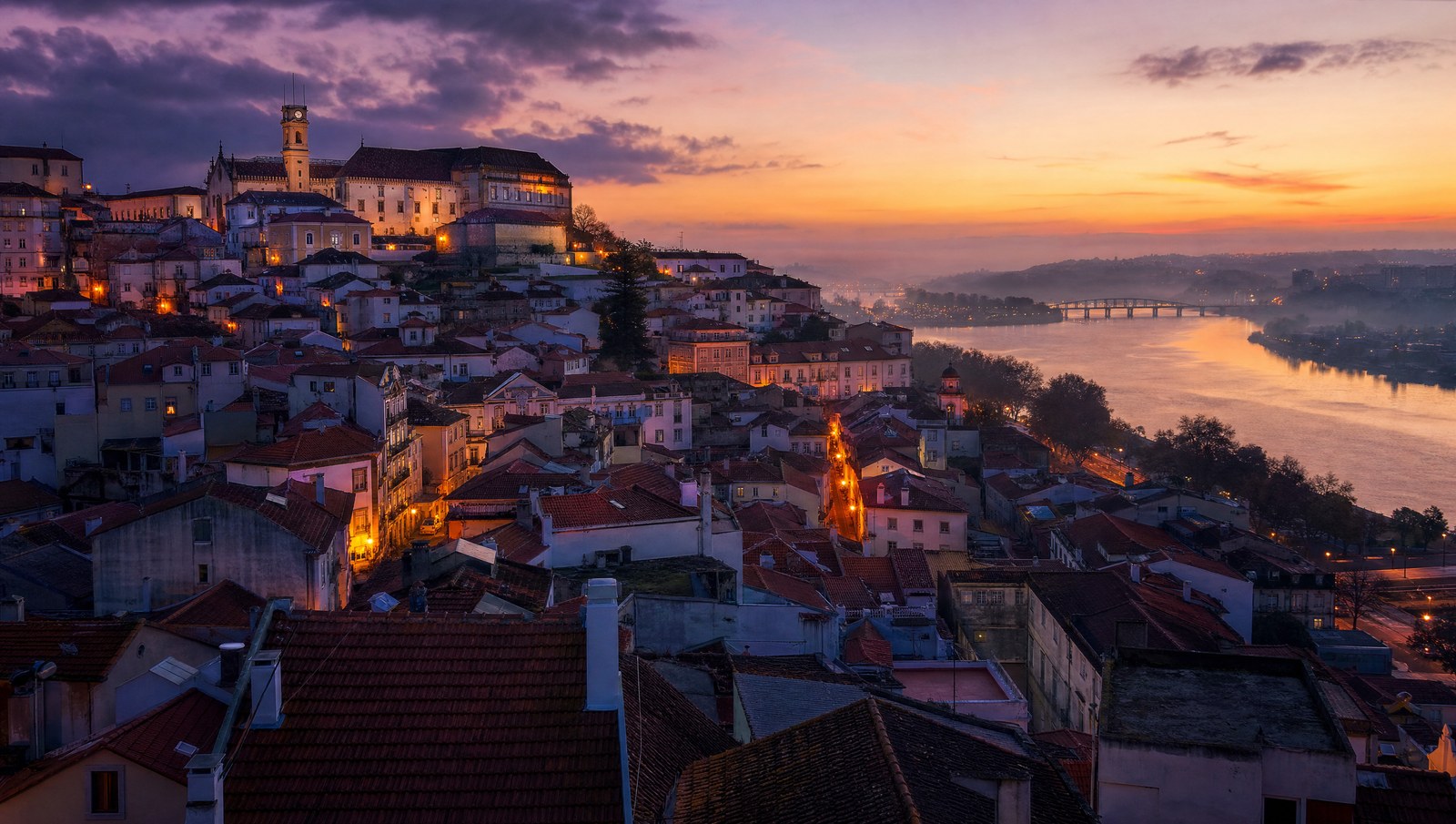
Coimbra belongs to the second family. It sits on a hill above the Mondego, and no matter what you do, you are climbing. The narrow streets tighten, the steps multiply, and the facades lean over your head like skeptical professors. When you finally emerge onto the Paço das Escolas, the university's great courtyard, your legs are heavy and you are short of breath. That is exactly what the city wanted. It made you pay for admission with effort.
On this late autumn morning, the river mist had not yet risen this high. The sun was striking the light stone of the Via Latina, the colonnaded gallery where Latin was long the only authorized language, and the tower bell had just rung. The students call it a cabra, the goat. It has governed academic life for centuries, and tradition dictates that a first-year student who returns too late after its final toll has some explaining to do.
Three women under the Porta Férrea
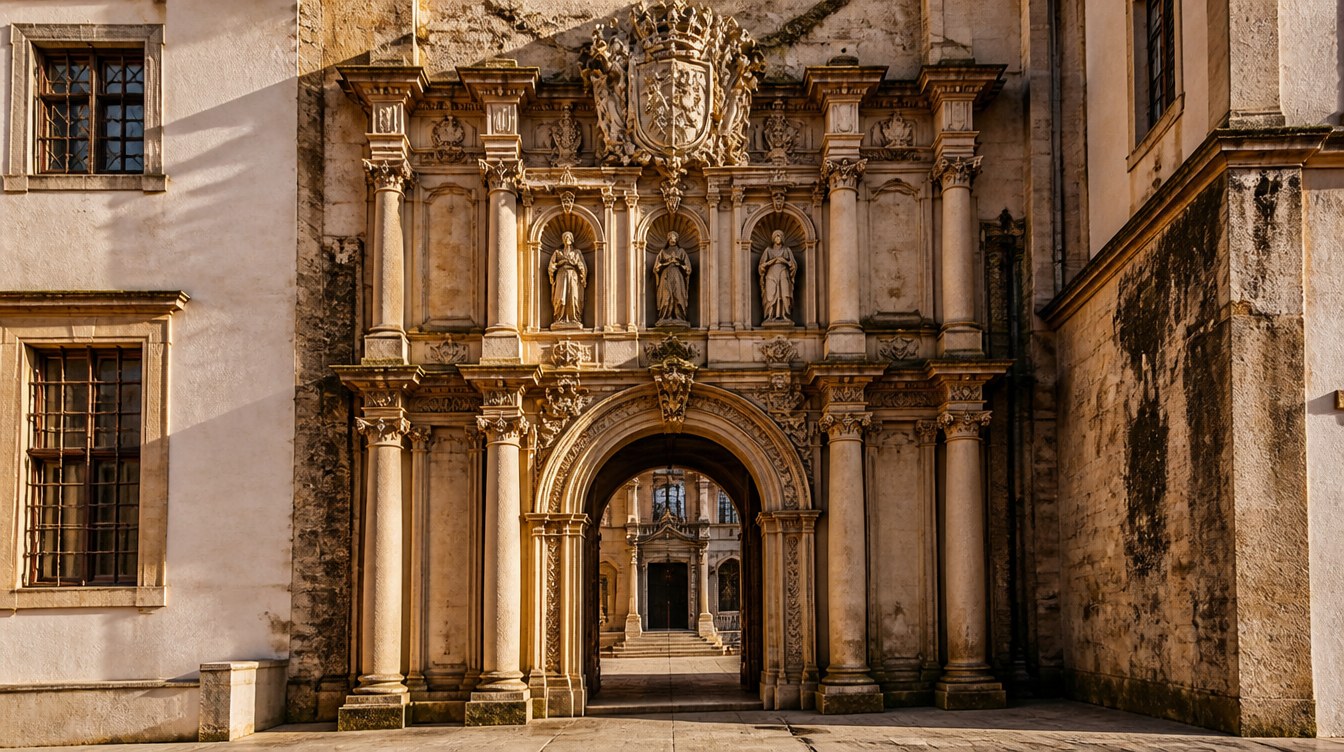
They were waiting for me under the Porta Férrea, the Iron Gate, with its statues of kings who size you up before letting you pass.
Camille arrived first, as always. Thirty-eight, French, a doctoral student in European humanism, her notebook already open before she had even seen anything. She had spent the night on the train from Paris and had that particular energy of people who haven't slept but are exactly where they wanted to be.
Matilde joined us next, unhurried. Fifty-five, Portuguese, a curator at the Biblioteca Joanina. She walked through the courtyard like someone walking through their own home, instinctively avoiding the loose cobblestones. When I asked her how long she had worked here, she thought for a second too long.
"Long enough to know which books complain when it rains."
And then Inês, twenty-two, from Coimbra, a student, a black cape thrown over her shoulder with that negligence that requires a great deal of care. Her father is a librarian at the university. She grew up within these walls the way others grow up in a garden.
"My father always says that here, you don't visit history," she said as she pushed open the gate. "You interrupt it."
The air smelled of cold stone and coffee drifting from an ajar door. Somewhere below, a Portuguese guitar was tuning its strings, poorly, patiently.
The king who bought brains
You need to understand one thing about this university, and it isn't obvious when you look at these walls that seem so sure of themselves.
For two and a half centuries, it didn't know where to live.
Founded in 1290 in Lisbon by King Dinis, under the name ofGeneral Studies, it was moved to Coimbra, then brought back to Lisbon, then sent back to Coimbra, at the whim of kings, epidemics, and quarrels with the locals. It was not until 1537, under John III, that it settled here permanently in the former royal palace. The university would eventually purchase this palace in 1597 from Philip II of Spain, who was also ruling Portugal at the time.
"This detail fascinates me," Camille said, looking up at the windows. "They didn't build a university. They took the king's house and put books in it."
John III didn't just want to house his university. He wanted to fill it with new ideas. He funded scholarships to send Portuguese students to study abroad—in Paris, Leuven, Italy—with the implicit instruction to return. He was buying brains, literally, and bringing them home.
Look closely, you who are reading these lines, because the same movement was sweeping through Europe at the same time.
In Paris, in 1530, Francis I appointed six royal lecturers: two for Greek, three for Hebrew, and one for mathematics. The idea came from the humanist Guillaume Budé. The University of Paris held a monopoly on knowledge and rejected new disciplines, so the king created a space alongside it where these subjects could be taught for free, open to all. This college of royal lecturers would become the Collège de France.
"Two kings, the same decade, the same reflex," Camille summarized. "Bypassing the university to save it from itself."
Matilde gave a small smile.
"Except that in Paris, it lasted five centuries. Here, it lasted three years."
The greatest principal in France
The name you need to remember is André de Gouveia.
A Portuguese man born in Beja around 1497, he left as a young man to study in Paris at the Collège Sainte-Barbe, which was run by his own uncle, Diogo de Gouveia. He taught there, then in 1534 took over as head of the Collège de Guyenne in Bordeaux. There, he became one of the most admired educators of his time. One of his Bordeaux students, a certain Michel de Montaigne, would later describe him as the greatest principal in France.
John III wanted this man. He got him. In 1547, Gouveia returned to Portugal to lead the new Colégio das Artes in Coimbra, and he didn't return alone. He brought part of his Bordeaux team with him: Frenchmen like Élie Vinet and Nicolas de Grouchy, Portuguese scholars like Diogo de Teive and João da Costa, and a Scotsman with a difficult temperament and sumptuous Latin, George Buchanan.
Imagine the scene. A Portuguese hill overlooking a river, and suddenly, overnight, people are speaking Latin with the accents of Bordeaux, Lisbon, and Edinburgh. Students flocked there. The college had over a thousand by the following year.
We stopped in the courtyard, at the exact spot where the sun cuts diagonally across the flagstones. Inês pointed to the windows with a nod of her chin.
"You know what feels strange to me? Most of them were my age. They had just arrived in a city they didn't know to listen to professors who had been brought in from elsewhere. It's exactly what I'm doing."
"Except that in your case, no one is going to arrest your professors," Matilde said.
There was a silence.
Gouveia, for his part, did not see what followed. He died less than a year after opening his college. The man around whom the entire enterprise had been built disappeared while the ink on the first lectures was barely dry.
October 1549
This is the moment the story turns.
John III, the same king who had paid to bring humanism to the country, had also established the Inquisition in Portugal in 1536. In his mind, these two actions were not contradictory. In practice, they became so.
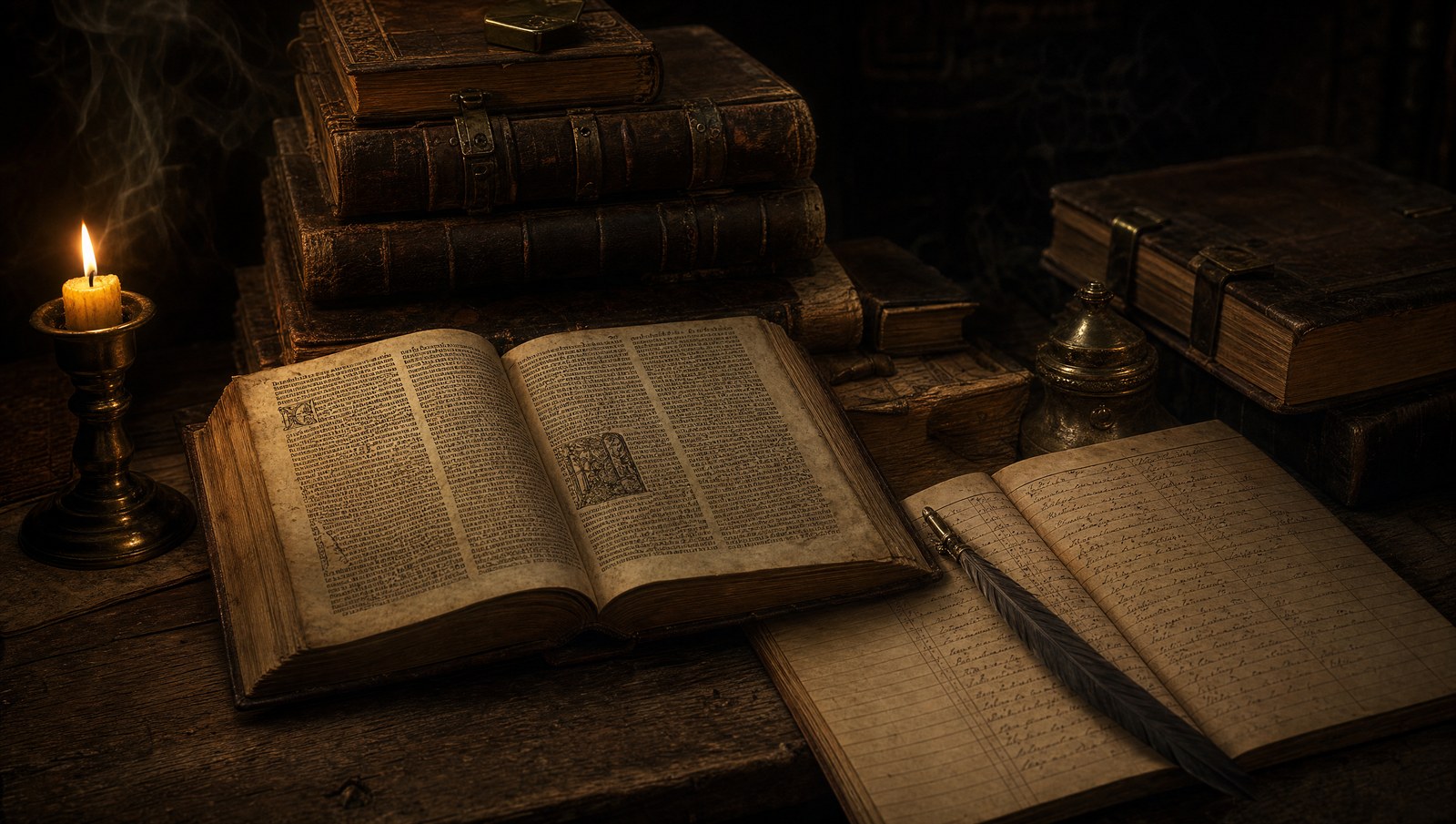
A commission of inquiry was appointed in October 1549 and delivered its findings in June 1550. In August 1550, George Buchanan and Diogo de Teive were arrested in Coimbra. João da Costa, who had taken over as head of the college, was also arrested. Their rooms were searched. A list of their books was drawn up.
"It's this detail that chills me," Camille said, her voice changed. "Not the chains. The inventory. Someone sat down, opened a ledger, and noted every title they owned."
They found theInstitutes of Calvin, and a few texts by Melanchthon. As for Buchanan, they also held against him his satirical poems about monks, written years earlier, in another country, in another life.
Coimbra did not remain silent. In September 1550, the jurist Martín de Azpilcueta, one of the most respected scholars on the peninsula, wrote to Queen Catherine to request their immediate pardon and to lament the harm done to the university. He was clever enough not to plead for the men's innocence, but for the damage done to the institution.
Buchanan was eventually locked away in the Santa Cruz monastery, at the bottom of that same hill, to be set back on the right path. There, he was made to translate psalms. He was released on February 29, 1552, and left the country as soon as he could, despite the offers made to keep him there.
There is a hypothesis that has long circulated among historians, and it is as beautiful as it is sordid. Diogo de Gouveia, the uncle, had coveted the directorship of the college for himself. Some suspect he incited the Inquisition against his nephew's team. Nothing definitively proves it. But the idea that one of Portugal's greatest intellectual adventures could have been shattered by a family grudge is something that stays with you once you've heard it.
Senhor Anselmo and the night watchmen
We headed back down toward the library in the late afternoon, when the light turns orange over the river.
In front of the Joanina door, a man in his sixties was folding large pieces of soft leather. Short gray hair, slow and precise movements, the air of someone who had been doing this for a very long time. Matilde greeted him by his first name. Senhor Anselmo.
I asked him what the leather was for.
"To cover the tables," he replied without looking up. "Every evening. Otherwise, in the morning, you have to clean everything."
He gestured toward the ceiling with a nod.
"Because of them."
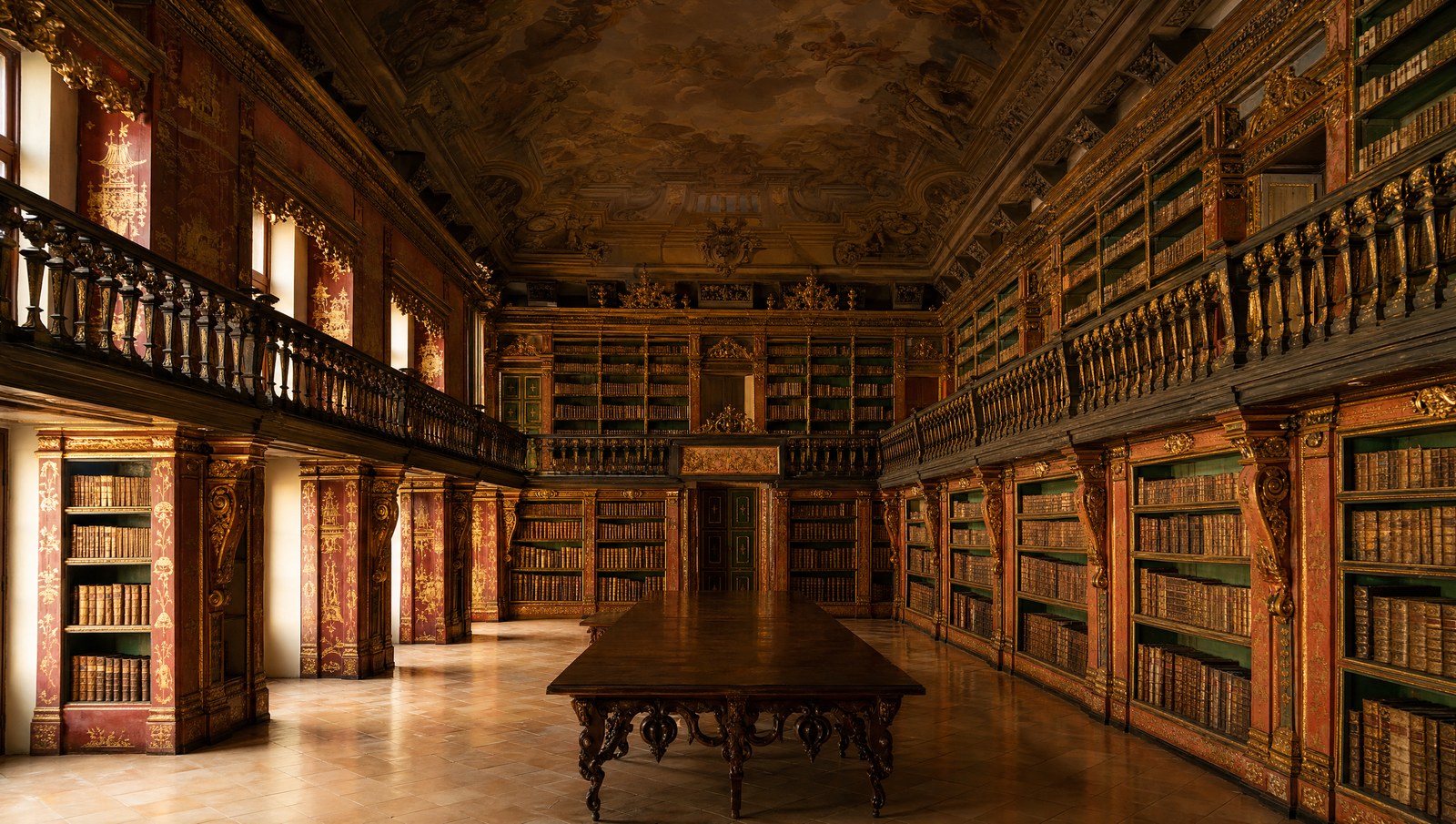
The Biblioteca Joanina houses a colony of bats. This isn't a tourist attraction; it's a system. At night, they emerge from behind the shelves and eat the insects that would otherwise devour the paper. The walls, over two meters thick, maintain a stable temperature, the oak wood repels worms, and the bats take care of the rest. A baroque library protected by an ecosystem.
Anselmo finished folding his leather, then said this, in a lower voice, as if sharing a secret.
"They say it's the old masters. The ones who were taken away. That they've returned to watch over the books that were taken from them, and that they only come out at night because they are no longer allowed to teach during the day."
No one said anything for a few seconds.
Then Camille, softly, almost regretfully:
"They're pipistrelles. They've probably been nesting there since the building was constructed in the 18th century. The professors we're talking about died two centuries earlier."
Anselmo shrugged, unoffended.
"I know. My grandmother told the story anyway."
And you, dear reader, do you see why I'm sharing both versions with you? Because neither cancels out the other. Legend is not a disguised fact. It is the way a city processes what it has been put through. Coimbra never truly forgave the fact that its masters were arrested in their rooms, so it brought them back in a form the Inquisition wouldn't have known how to judge.
What remains on the hill
The library where Matilde works has nothing to do with the 16th century. It was commissioned by John V, built between 1717 and 1728, paid for with Brazilian gold, and covered in gilding and chinoiserie across three sumptuous rooms. It is regularly cited as one of the most beautiful libraries in the world, and it knows it.
But it houses tens of thousands of volumes from the 16th, 17th, and 18th centuries. That is to say, the books of those men, or their direct cousins, printed in the same years, with the same typefaces.
And just below, under the flagstones, is the old academic prison.
A prison beneath a library. I don't know of any building that better summarizes what this hill was.
Matilde left us just as the lamps were being turned on.
"You know what I think sometimes? That John III succeeded. Three years is nothing. But Buchanan left here and wrote elsewhere. Vinet returned to Bordeaux and taught. What they learned here left with them."
She pointed to the city below, the rooftops, the river already taking on the color of the evening.
"We always think a library keeps books. Mostly, it keeps what people did with them before they moved on."
Students were walking up the street in black capes, laughing, shouting, exactly as they must have done five hundred years ago. A king paid a fortune to bring Europe to this hill. A tribunal undid his work in three years. And yet here you are, today, listening to a bell they call the goat.
You who are reading this, tell me one thing. How long does it take for an idea to take root somewhere? Three years, apparently. That's short for an institution. It's more than enough for a generation of students.
Category: Cultural landscapes · Country: Portugal · Location type: Universities
You know, digging up these stories comes at a price. Traveling to these places, consulting archives, and verifying every date with historians takes time—and for an independent author, time is the only currency that truly matters.
If these stories resonate with you, supporting this work costs less than a coffee and a glass of Portuguese wine. For €5 a month, you get the newsletter, the latest stories, and early access to two new ones before anyone else. Plus, as long as you’re a member, the entire Library is yours: 14 ebooks already written, with a total value of €138.60, all included in your subscription.
If you ever decide to leave, none of the ebooks disappear: you can always purchase them individually for €9.90 each.
Because a journey never truly ends. It continues, somewhere between the pages and the memories. Lucas Lunes, author of Ancient Stones