Listen to the story — narrated audio
Your travel chronicle in Spain, focusing on Huesca and the fields of Alcoraz, with Peter I of Aragon (11th century) during the Reconquista and the siege of the city—at a time when, two centuries later, Saint George would become the patron saint of England under Edward III.
Your Daily Iberian Travel Chronicle & Guide
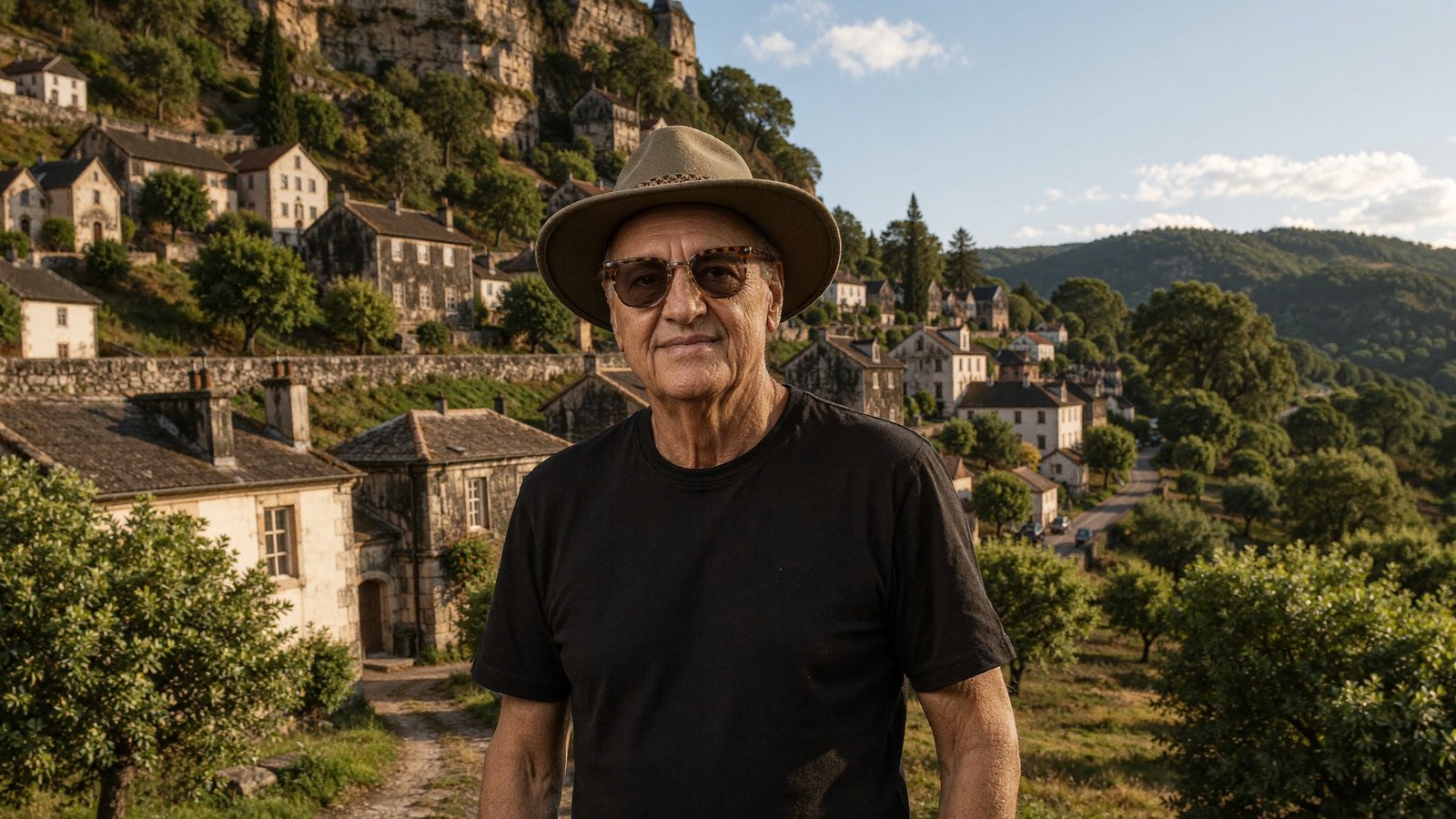
You know, some saints belong to everyone and no one. Saint George is one of them. You think of him as English, strapped in his red cross on a white background, brandished by kings who had never seen the Mediterranean. And then you climb a barren hill above Huesca on a morning when the Aragonese wind dries your lips, and you realize he galloped here first. Long before London. Long before the Garter.
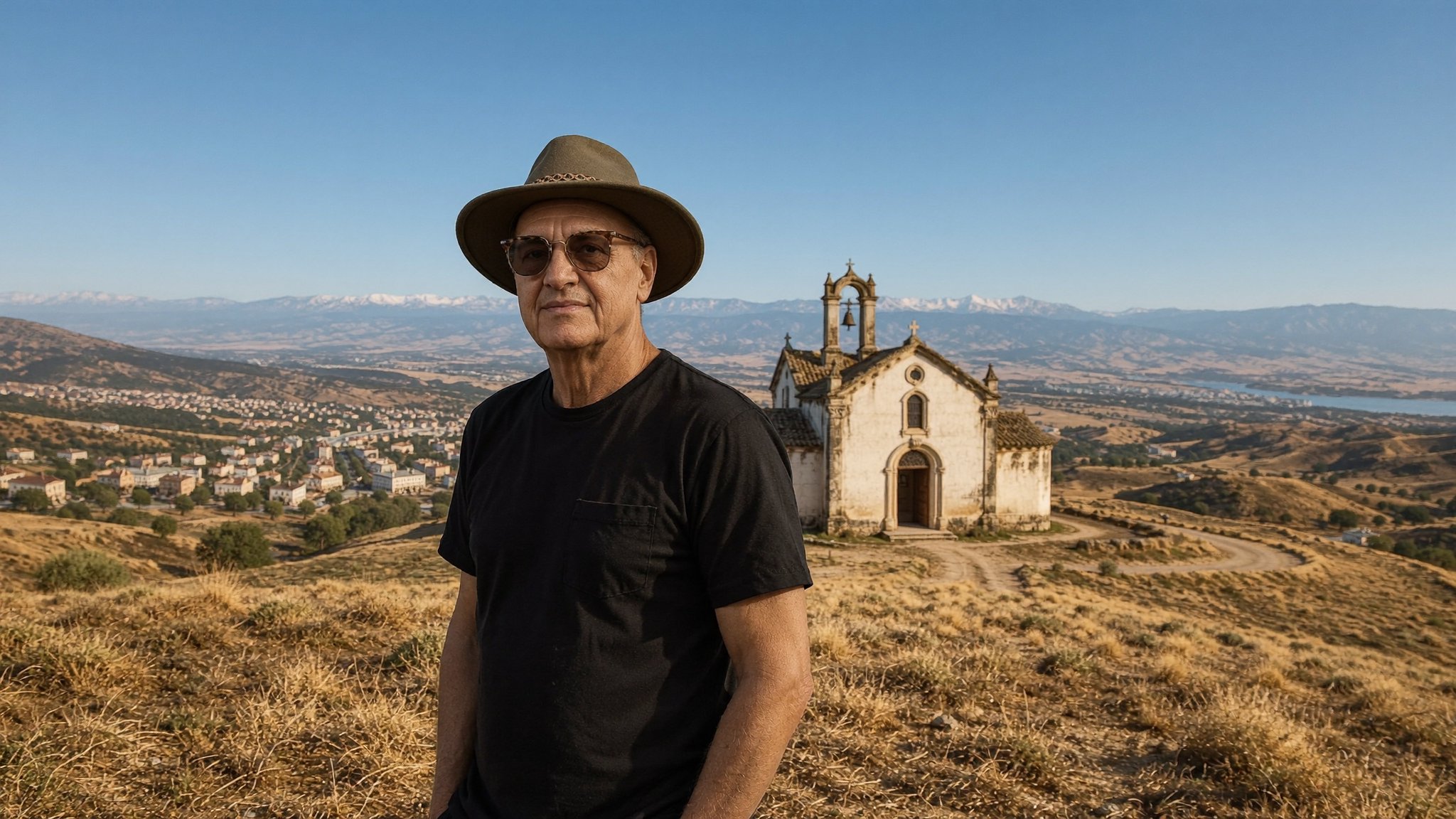
I arrived via the road from Zaragoza, the light still low, the Pyrenees set to the north like a threat of snow. Huesca doesn't give itself up easily. It waits for you to climb. And that is where I am taking you today, up on the Cerro de San Jorge, that dry, humped hill where they say a celestial horseman turned the tide of a battle. Look closely, you who read these lines: beneath the short grass and the thistles, there is a field where two worlds collided on November 15, 1096.
Three travelers on a windy hill
They were already waiting for me at the top, leaning against the low wall of the hermitage. Pilar first, sixty-five years old, a native of Huesca, a scarf tied under her chin against the gusts. Her grandfather used to tell her the legend of Saint George when she was a child, in the evenings, while peeling almonds. "He said the saint descended from the sky right where you're standing," she says with a laugh, her laughter lost in the wind.
Beside her, Eleanor, fifty, an English historian from Coventry and a specialist in the cult of Saint George. She has spent her life tracking this saint across Europe, from the stained glass of Oxford to the icons of Cappadocia. She is here for a specific reason, and she says it plainly: "Back home, we think we invented him. That's wrong. We borrowed him."
Finally, Jorge, forty, an archaeologist working for the city. His name makes everyone smile, him first of all. "My parents didn't have much choice, here," he sighs, gesturing toward the hermitage behind us. He has the wary look of those who dig into the earth to verify what others are content to believe. You, dear reader, will like Jorge: he is our voice of reason.
The sun was rising. Below, Huesca spread out, its ochre roofs, the pale mass of the cathedral, and in the distance, on another height, the ruins of Montearagón Castle. Jorge pointed toward that distant silhouette. "Those are the two jaws of history," he said. "The city and the castle. And between them, this field where we stand. This is where it all happened."
An arrow in the twilight

To understand, we must go back two years, to 1094. Sancho Ramírez, King of Aragon and Pamplona, had laid siege to Huesca. The city was one of the great Muslim strongholds of the north—rich, walled, and arrogant. Taking it meant opening up the Ebro Valley.
"He never saw it fall," Pilar whispered. And Jorge confirmed, soberly: one evening, while inspecting the ramparts, King Sancho was struck by an arrow. He died from it. It was June 1094. Imagine the scene, you who are reading this: a king prowling at the foot of the walls, the light fading, a single arrow fired from a battlement, and the crown of Aragon changing heads in a second.
His son, Peter, immediately took up the body and the promise. Peter I of Aragon and Pamplona was not a man to lift a siege to bury his father. He buried his father and kept the siege. For two years, he held Huesca by the throat.
Eleanor was taking notes, the wind flapping the pages of her notebook. "What fascinates me," she said without looking up, "is that this whole story hinges on geography. The father dies at the foot of the wall. The son wins in the field. And the saint, he arrives from the sky. Three levels of the same legend."
November 15, in the dust of Alcoraz
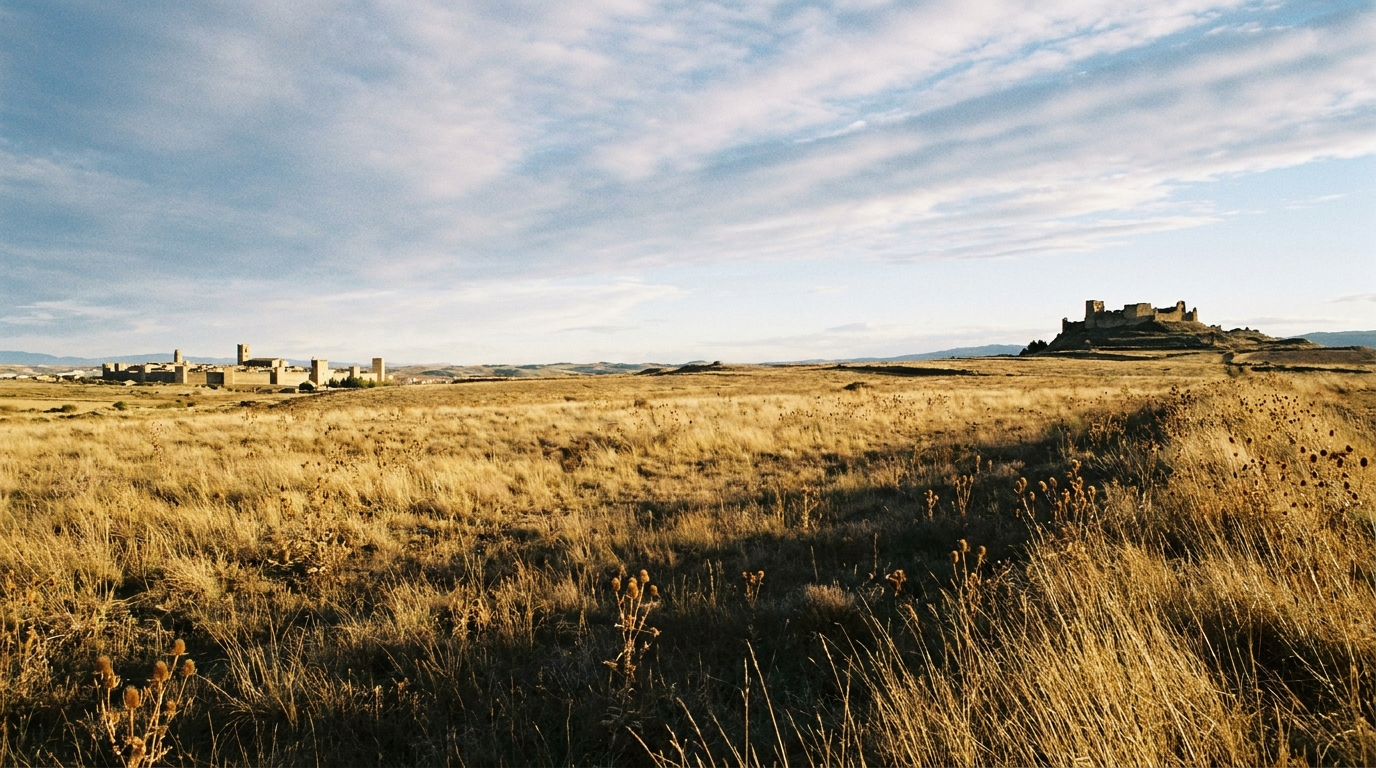
A besieged city calls for help. Huesca called for Zaragoza. And the king of the Taifa of Zaragoza, al-Musta'in II, marched north to break the siege. He was not alone: riding at his side were Christian lords from Castile, García Ordóñez and Gonzalo Núñez de Lara, who had come to lend their lances against Aragon. Because in this 11th-century peninsula, the border didn't always run where you think it did. Christians and Muslims allied, betrayed, and sold each other out according to the seasons and their grudges.
Jorge crouched down, picked up a handful of dry earth, and let it slip through his fingers. "November 15, 1096," he said. "Right here, on the fields of Alcoraz, between the city walls and Montearagón Castle. The relief army against Peter's." He paused. "Peter crushed them."
The victory was decisive. The Muslim-Castilian coalition was broken and scattered. And Huesca, deprived of all hope, with no one left to loosen the grip, surrendered less than two weeks later. The great walled city finally fell into Aragonese hands, two years and one arrow after the old king's death.
"Do you see the logic?" Eleanor said to me. "No miracle in that. A siege maintained, a relief army defeated, a surrender. Strategy, tenacity, blood." She closed her notebook. "And yet, that is not the story people remembered."
No. That is never the story we remember.
The rider from the sky
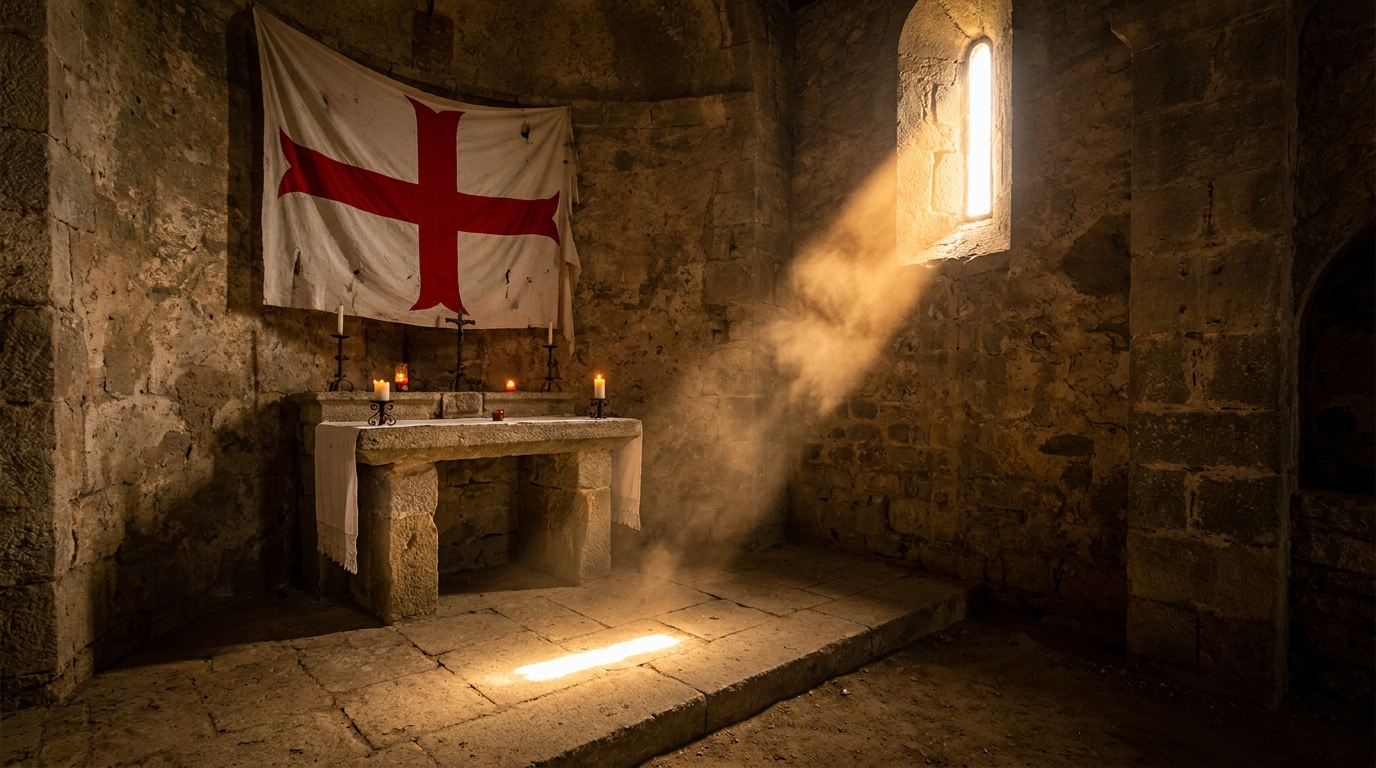
That was when a man came up to meet us. A caretaker, Ramón, with the key to the hermitage hanging from his belt and a face as weathered as saddle leather. He comes to open the chapel for the rare visitor, to sweep away the dust, to keep the flame of a thousand-year-old devotion alive. He stood before us, delighted to have an audience.
"They say," he began—and the word was fitting, they say—"that at the height of the fray, when everything hung in the balance, a knight appeared above Peter’s army. Armor catching the light, a red cross, a white horse. Saint George himself, descended to fight for Aragon." Ramón raised a hand toward the empty blue sky. "There. Right there. And the Moors, it is said, saw the white death swooping down upon them."
Pilar nodded, moved in spite of herself by this childhood tale. But Jorge, our archaeologist, gently laid the truth on the table without breaking the spell. "The apparition is the legend, Ramón. It came later, growing with the centuries. The battle, however, is very real. The victory, too. The rest is what the victors needed to believe to make sense of their good fortune."
Ramón wasn't offended. "Perhaps," he said with a shrug. "But tell me, Mr. Archaeologist, why is this hill called San Jorge? Why this hermitage? Why does all of Aragon celebrate Saint George as its patron every April 23rd?" He smiled, toothless and sly. "A legend that builds chapels is no longer entirely a legend."
And he wasn't wrong. That is the true legacy of Alcoraz: not an apparition, but a patronage. Saint George became the saint of Aragon, celebrated on April 23rd, the day that still honors the entire Aragonese land today. The hill bears his name. The hermitage watches over the field. Belief has left behind stones, and stones, you can touch.
What England borrowed
Eleanor had been waiting for this moment from the start. She stepped forward, wind in her hair, and restored Saint George to his full journey.
"Look at what you did here in 1096," she said. "You took a martyr from the East, a soldier who died in Cappadocia centuries earlier, and turned him into a warrior of the Reconquista. A saint who wins battles." She paused. "Two centuries later, my country did exactly the same thing."
For Saint George is not originally English at all. The Crusaders brought him back from the East, invoking him in the dust of the Holy Land campaigns. It was in the mid-14th century that a King of England, Edward III, raised him to the rank of patron of the realm. By founding his Order of the Garter around 1348, he placed it under the protection of Saint George, and the warrior saint gradually became the emblem of all England, his red cross stitched onto the banners of every battlefield to come.
"Do you see the irony?" Eleanor smiled. "The same saint, three hundred leagues and two hundred years apart, decides an Aragonese battle and founds an English order of chivalry. Huesca doesn't know it. Neither does London. And yet it is the same cross, the same horse, the same human need to believe that a heaven is watching us fight."
You who are reading this, pause for a second on this thought. A saint does not belong to the country that brandishes him. He belongs to the fear of men, to their desire to have an ally greater than themselves at the moment of death. Aragon and England, without ever consulting one another, had the same reflex. They called out the same name in the storm.
Descending back to the stone kings
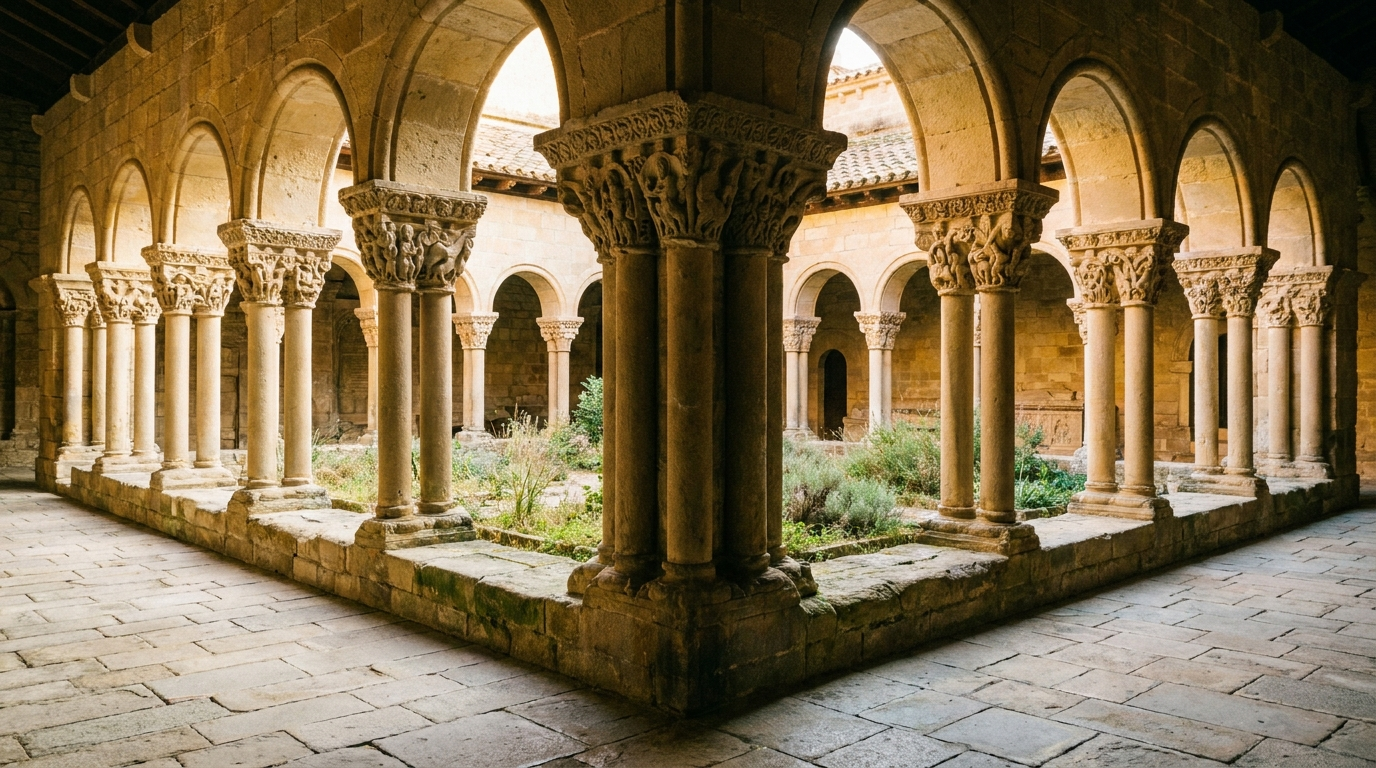
We headed back down when the light shifted, softer and golden over the rooftops of Huesca. Jorge wanted to show me one last thing in town, in the old Romanesque cloister of San Pedro el Viejo. It is there, beneath the worn capitals, that two Kings of Aragon rest: Alfonso the Battler and Ramiro the Monk. Successors to that Peter who won Alcoraz. Men of flesh, they were, without halos, whose names can be read on the cold stone.
Pilar brushed a column with her fingertips. "This is what I prefer," she said softly. "Up there on the hill, there is the saint you cannot prove. Down here, there are the kings you can touch. And in between, you live. Between what you believe and what you know."
Eleanor put away her notebook. Ramón had stayed up there with his key and his empty chapel. Jorge was looking at his hands, still dusted with the soil of Alcoraz. And I was thinking of that arrow from 1094, of that father who fell at the foot of a wall he would never see breached, and of his son who had transformed a mourning into a kingdom.
And you, dear reader, when you brandish a symbol, a cross, a flag, a name, remember that it may have traveled further than you. That it has served other causes, other fears, other battles, on hills whose names you do not even know. Saint George knows. He has galloped across many skies.
Category: Great battles · Country: Spain · Location type: Sites of memory
You know, digging up these stories comes at a price. Traveling to these places, consulting archives, verifying every date with historians—it takes time, and for an independent author, time is the only currency that truly matters.
If these stories resonate with you, supporting this work will cost you less than a coffee and a glass of Portuguese wine. For €5 a month, you get the newsletter, the latest stories, and two early-access pieces before anyone else. And as long as you’re a member, the entire Library is open to you: 14 ebooks already written, with a total value of €138.60, all included in your subscription.
If you ever decide to leave, none of the ebooks will truly disappear: you can always purchase them individually for €9.90 each.
Because a journey never really ends. It continues, somewhere between the pages and the memory. — Lucas Lunes, author of Ancient Stones